 SAME DAY & EXPEDITED SHIPPING AVAILABLE






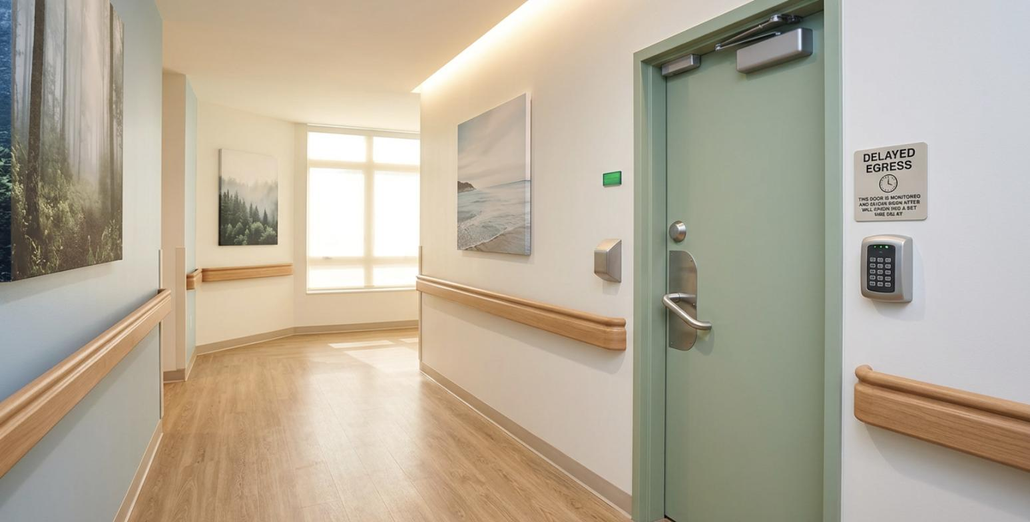
Senior Living and Behavioral Health Anti-Ligature and Delayed Egress
Posted by National Lock Supply on Jun 17th 2026
Senior living and behavioral-health facilities specify door hardware around one overriding requirement the rest of commercial work does not face: patient self-harm and elopement risk. That drives two specialized hardware families. Anti-ligature (ligature-resistant) hardware uses sloped, closed, or recessed shapes that give nothing to attach a cord to, on the doors of at-risk patient areas. Delayed egress and controlled access manage wander and elopement risk in memory-care and secure units without locking residents in. Both must coexist with ADA, fire, and free-egress code. This guide separates the two problems, specs hardware by area, and explains where ligature-resistant trim is mandatory versus where standard commercial hardware is correct.
Two different problems, two different hardware sets
These facilities mix populations and risk profiles, so the building has to be zoned:
- Anti-ligature zone (behavioral patient rooms, bathrooms, seclusion, at-risk areas): ligature-resistant levers, pulls, hinges, and closers that present no attachment point.
- Wander / elopement zone (memory care, secure dementia units): delayed egress and access control to slow unsupervised exit while keeping egress lawful.
- Standard commercial zone (offices, corridors, support, general assisted living): conventional Grade 1 commercial hardware.
Mixing these up is the core error. Anti-ligature hardware is expensive and unnecessary in offices, while standard levers are dangerous in a behavioral patient room. The general healthcare baseline is in commercial door hardware for healthcare facilities and hospitals, and this article covers the senior-living and behavioral specialization on top of it.
Anti-ligature hardware: what makes hardware ligature-resistant
Ligature-resistant hardware removes the protrusions a cord or fabric could be tied to. The defining features are consistent across the product family:
- Sloped or closed levers and pulls with no gap between the lever and the door face, so a cord slides off rather than catching.
- Continuous (piano) hinges or sloped hinge caps instead of butt-hinge knuckles that create attachment points.
- Recessed or sloped closers and overhead devices, or closers concealed in the frame.
- Anti-barricade capability on patient rooms so staff can enter even if a patient obstructs the door.
These are specialized institutional or asylum-function locksets and ligature-resistant trims. A lock built for the function, such as the Sargent institutional/asylum mortise lock, pairs the controlled function with the heavy-duty chassis these doors require. The function-code logic behind asylum and institutional functions is in commercial lock function codes explained.
Delayed egress and controlled access for wander risk
Memory-care and secure dementia units must prevent residents from leaving unsupervised while never trapping anyone. The tools:
- Delayed egress (ANSI/BHMA A156.24): a 15-second hold with alarm before release, releasing on fire alarm and power loss. It slows elopement without locking residents in. See how to choose an exit door alarm and the standards context in the BHMA A156 series cheat sheet.
- Controlled access with the right fail mode. Any electrified or magnetic device on a resident-unit perimeter must release on alarm and power loss, so confirm the logic against how to choose a magnetic lock (maglock) and fail-safe vs fail-secure.
- Request-to-exit (REX) devices to manage authorized staff and resident movement without nuisance alarms. See how to choose a request-to-exit device (REX).
Special locking arrangements in healthcare are tightly governed by NFPA 101 and the AHJ, so confirm the unit classification before specifying any egress-delaying device.
Where anti-ligature is required versus where standard hardware is correct
The cost discipline that keeps a project on budget is matching hardware to the actual risk of each area.
| Area | Hardware |
|---|---|
| Behavioral patient room / bathroom / seclusion | Anti-ligature lever, pull, hinge, closer, plus anti-barricade |
| Memory-care / secure dementia unit perimeter | Delayed or controlled egress plus access control |
| General assisted-living resident room | Standard Grade 1 commercial lever (privacy with staff key override) |
| Corridors, offices, support, dining | Standard Grade 1 commercial hardware |
| Required building exits | Panic/exit hardware, free egress |
Privacy functions in resident rooms should include a staff emergency key override so caregivers can enter, not a coin-slot tool. The privacy and override logic ties back to commercial lock function codes explained. ADA applies throughout: lever operation, force, and clearances must comply even on specialized hardware. See ADA compliance for commercial door hardware.
Common senior-living and behavioral hardware mistakes
- Anti-ligature everywhere. It is expensive and only required in at-risk patient areas. Offices and corridors use standard hardware.
- Standard levers in behavioral patient rooms. They create ligature points. Specify ligature-resistant trim.
- Locking memory-care exits outright. Use delayed or controlled egress that releases on alarm and power loss, never a hard lock.
- Privacy lock with no staff override. Caregivers must be able to enter, so specify an emergency key override.
- Skipping AHJ sign-off on special locking. NFPA 101 and the AHJ govern healthcare egress locking, so confirm before specifying.
The regulators behind anti-ligature: Joint Commission, CMS, and the code
Anti-ligature hardware is not a style choice, it is a response to specific oversight. In behavioral health and psychiatric settings, the Joint Commission and the Centers for Medicare and Medicaid Services (CMS) evaluate the patient environment for ligature risks, and a single non-compliant lever, hinge, or closer arm can drive a survey finding. That is why ligature-resistant design extends past the lock to the whole opening: sloped tops, closed loops eliminated, breakaway hardware that releases under a set load, and continuous or anti-ligature hinges that leave no graspable gap.
The building code adds a second layer through occupancy classification. Skilled-nursing and many memory-care units fall under I-2 institutional occupancy, where NFPA 101 and the IBC permit controlled egress and special locking arrangements precisely because residents cannot safely self-evacuate. Those provisions require that locks release on a fire alarm, on power loss, and on activation of the building's automatic sprinkler or smoke-detection system, and that movement within each smoke compartment stays possible. Door position monitoring and alarmed egress points then give staff a real-time picture of who is moving through a secure unit, which is how a facility balances elopement control against the resident's right to a non-restrictive environment.
FAQ
What is anti-ligature door hardware?
Ligature-resistant hardware uses sloped, closed, or recessed shapes (levers, pulls, hinges, closers) that give a cord or fabric no attachment point. It is specified in behavioral-health and at-risk patient areas to reduce self-harm risk.
Can memory-care units lock residents in?
No. They use delayed egress or approved controlled egress that holds the door briefly and releases on fire alarm and power loss, slowing elopement without trapping residents. Special locking requires AHJ approval under NFPA 101.
Do all senior-living doors need anti-ligature hardware?
No. Anti-ligature is for behavioral and at-risk patient areas. General assisted-living rooms, corridors, and offices use standard Grade 1 commercial hardware, which keeps the project on budget.
Should resident-room privacy locks have a key override?
Yes. Specify a staff emergency key override so caregivers can enter in an emergency, rather than a residential-style coin-slot privacy release.
How do anti-ligature and delayed egress work together on a secure unit?
Anti-ligature trim protects the individual patient-room doors while delayed or controlled egress governs the unit perimeter, so self-harm risk and elopement risk are each handled by the right hardware without compromising egress.
Next step
Zone the facility: ligature-resistant hardware only in behavioral and at-risk areas, delayed or controlled egress on wander-risk unit perimeters, and standard Grade 1 hardware everywhere else, with ADA and free egress preserved throughout. Browse cylindrical lever locks, mortise locks, and electric strikes. Our commercial desk specs ligature-resistant and controlled-egress packages and confirms NFPA 101 egress compliance with your AHJ.