 SAME DAY & EXPEDITED SHIPPING AVAILABLE






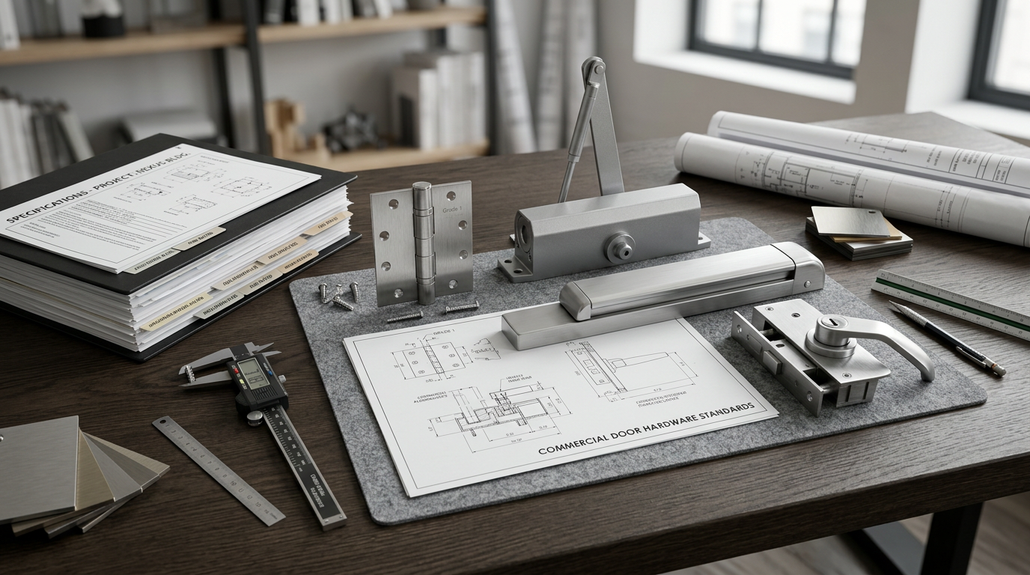
BHMA A156 Series Cheat Sheet: Complete Guide
Posted by National Lock Supply on May 11th 2026
ANSI/BHMA A156 is the family of performance standards that defines how commercial door hardware is tested, graded, and labeled. There are 40+ individual standards in the series. Each covers one hardware category (hinges, locks, exit devices, closers, electric strikes, etc.) and defines cycle counts, force tests, and grade thresholds. A spec book references the standard number and grade ("ANSI/BHMA A156.13 Grade 1") to lock in a quality floor. This guide maps every A156 standard to the hardware it covers, explains what Grade 1, 2, and 3 mean inside each standard, and shows how the standard interacts with UL listings and code adoption.
What BHMA is and what A156 covers
The Builders Hardware Manufacturers Association (BHMA) is the ANSI-accredited standards developer for builders hardware. The A156 series is the umbrella for hardware performance standards. Each individual standard (A156.1, A156.2, A156.3…) covers one product category.
Three things every A156 standard defines:
- Performance tests: cycle counts, force loads, durability tests specific to the hardware type.
- Grade thresholds: Grade 1 (highest), Grade 2 (medium), Grade 3 (light commercial or residential).
- Labeling and marking: how a manufacturer claims compliance.
A156 standards do not define dimensions, finishes, or installation methods. Those live in companion standards (A156.115 for installation, A156.18 for finishes).
Standard-by-standard map
The table covers the most-referenced standards. Less-referenced ones (A156.6 architectural door trim, A156.27 power and manual operated revolving doors) exist but are rarely cited in commercial specs.
|
Standard |
Title |
Hardware category |
|
A156.1 |
Butts and Hinges |
Standard butt hinges, ball-bearing hinges |
|
A156.2 |
Bored and Preassembled Locks and Latches |
Cylindrical lever and knob locks |
|
A156.3 |
Exit Devices |
Panic devices, exit bars |
|
A156.4 |
Door Controls (Closers) |
Surface-mounted and concealed door closers |
|
A156.5 |
Cylinders and Input Devices for Locks |
Cylinders, keyways, electronic input |
|
A156.6 |
Architectural Door Trim |
Push plates, pulls, kick plates |
|
A156.7 |
Template Hinge Dimensions |
Hinge templating, not a performance standard |
|
A156.8 |
Door Controls (Overhead Stops and Holders) |
Overhead stops and holders (Glynn-Johnson, Rixson, Rockwood) |
|
A156.10 |
Power Operated Pedestrian Doors |
Automatic swing operators |
|
A156.11 |
Cabinet Locks |
Cabinet, cam, and drawer locks |
|
A156.12 |
Interconnected Locks and Latches |
Locks that combine deadbolt and latch in one chassis |
|
A156.13 |
Mortise Locks and Latches |
Heavy-duty mortise locksets |
|
A156.14 |
Sliding and Folding Door Hardware |
Track hardware for sliding/folding doors |
|
A156.15 |
Closer-Holder, Release Devices |
Door holders for fire alarm release |
|
A156.16 |
Auxiliary Hardware |
Door stops, silencers, hooks, miscellaneous |
|
A156.17 |
Self-Closing Hinges |
Spring hinges |
|
A156.18 |
Materials and Finishes |
Finish codes (626, 630, 689…) |
|
A156.19 |
Power-Assist and Low-Energy Power-Operated Doors |
ADA-compliant low-energy operators |
|
A156.20 |
Strap and Tee Hinges |
Strap and tee hinges |
|
A156.21 |
Thresholds |
Saddle and bumper thresholds (Pemko, NGP, Reese) |
|
A156.22 |
Door Gasketing and Edge Seal Systems |
Weatherstripping, smoke seals |
|
A156.23 |
Electromagnetic Locks |
Maglocks (Securitron M62, Schlage M490) |
|
A156.24 |
Delayed Egress Locks |
Delayed egress locking with 15-second timer |
|
A156.25 |
Electrified Locking Devices |
Electric mortise and cylindrical locks |
|
A156.26 |
Continuous Hinges |
Continuous geared and pin-and-barrel hinges (Pemko CHS, Markar) |
|
A156.28 |
Recommended Practice for Keying Systems |
Master keying, sub-master, grand master |
|
A156.29 |
Exit Locks and Alarms |
Exit locks (Detex ECL series) and exit alarms (Detex EAX) |
|
A156.30 |
High Security Cylinders |
Medeco, Mul-T-Lock, ASSA, Schlage Primus |
|
A156.31 |
Electric Strikes and Frame-Mounted Actuators |
Electric strikes (HES, Folger Adam, Trine) |
|
A156.32 |
Integrated Door Opening Assemblies |
Pre-hung and pre-assembled openings |
|
A156.33 |
Battery-Operated Locks With Key Override |
Standalone battery locks (Alarm Lock DL series, Kaba E-Plex) |
|
A156.34 |
Bored Lock Adaptations for Decorative Knobs |
Conversion kits |
|
A156.35 |
Power Supplies for Access Control Devices |
Regulated 12/24VDC power supplies |
|
A156.36 |
Auxiliary Locks |
Deadbolts (standalone, not interconnected) |
|
A156.38 |
Low Energy Power Operated Sliding and Folding Doors |
Low-energy slider operators |
|
A156.39 |
Residential Locksets and Latches |
Residential cylindrical (not commercial) |
|
A156.40 |
Residential Deadbolts |
Residential deadbolts |
For exit device options against A156.3, see exit device types: rim vs SVR vs mortise vs CVR. For closer options against A156.4, see how to choose a commercial door closer.
ANSI Grade 1 vs Grade 2 vs Grade 3 inside each standard
The grade is the performance tier within a standard. Each standard defines its own grade thresholds, but the pattern is consistent.
|
Standard |
Grade 1 (highest) |
Grade 2 (medium) |
Grade 3 (light) |
|
A156.2 (cylindrical) |
1,000,000 cycles, 360 lbf |
800,000 cycles, 250 lbf |
400,000 cycles, 150 lbf |
|
A156.3 (exit) |
500,000 cycles |
250,000 cycles |
100,000 cycles |
|
A156.4 (closers) |
Multi-grade by size and arm type |
n/a |
n/a |
|
A156.13 (mortise) |
1,000,000 cycles, 1,000 lbf |
800,000 cycles, 800 lbf |
400,000 cycles, 600 lbf |
|
A156.23 (maglocks) |
1,500 lbf holding, security tested |
1,000 lbf |
600 lbf |
|
A156.31 (electric strikes) |
1,000 lbf static, 100k cycles |
500 lbf static |
250 lbf static |
The takeaway: Grade 1 is the commercial spec for high-traffic, security-sensitive openings. Grade 2 is acceptable for low-traffic interior openings. Grade 3 is residential or very light commercial.
Read what is Grade 1 lock hardware for the practical buying implications.
How to cite an A156 standard correctly in a spec
A correct spec citation includes the standard number, the grade, and any sub-options.
Examples:
- ANSI/BHMA A156.13 Grade 1 Operational, Grade 1 Security, Series 1000
- ANSI/BHMA A156.4 Grade 1, Size 4 adjustable
- ANSI/BHMA A156.31 Grade 1, Continuous Duty, Fail-Secure
- ANSI/BHMA A156.23 Grade 1, 1500 lbf holding force, Indoor
The spec should not say "ANSI Grade 1" without naming the standard. ANSI is the umbrella; the A156 number is the specific standard.
How BHMA references appear in UL listings and code adoption
BHMA A156 standards intersect with two other documents:
UL listings:
- UL 305 covers panic hardware (overlaps with A156.3).
- UL 1034 covers burglary-resistant electric locking mechanisms.
- UL 10C covers fire-rated door assemblies (closers, locks, exit devices on rated doors).
A piece of hardware can be UL-listed without being BHMA A156 Grade 1. Specs that require both must call both out.
Code adoption:
- IBC (International Building Code) references BHMA standards in Chapter 10 (means of egress).
- NFPA 80 references hardware via fire door labels rather than BHMA directly.
- NFPA 101 (Life Safety Code) references panic hardware listings (UL 305 plus A156.3).
- Local AHJ may overlay additional requirements.
The IBC/NFPA stack defers to UL and BHMA for the actual hardware spec. The codes set the application rules (where panic hardware is required, how doors must swing in the egress direction).
For NFPA 80 specifically, read NFPA 80 annual fire door inspection.
When a Buy American or GSA spec overrides the BHMA-only call
Federal projects (GSA, military, VA) add layers beyond BHMA:
- Buy American Act: hardware must be domestically manufactured or qualify under a waiver. Most BHMA Grade 1 hardware from US manufacturers (Sargent, Schlage, Yale, Norton, LCN, Adams Rite, Von Duprin, HES) qualifies. Imported components may need waivers.
- GSA approval: specific hardware must appear on a GSA-approved list for certain federal projects.
- Federal Standards (FS): some specs reference Federal Standards (e.g., FF-H-106) for hardware. These are older and largely superseded by BHMA, but still appear in federal documents.
- Department of Defense specs: military projects (UFGS) add UL 437 (security cylinders) and FF-L-2740 (high-security locks for classified containers).
If a project spec includes "Buy American" or "GSA-approved", confirm before quoting. The BHMA-only spec is usually a fallback when Buy American is not in play.
Common spec mistakes
- Citing the grade without the standard. "Grade 1 mortise lock" is ambiguous. The correct call is "ANSI/BHMA A156.13 Grade 1 mortise lock".
- Mixing residential and commercial standards. A156.39 and A156.40 are residential; using them in a commercial spec creates a quality floor that is too low.
- Missing the fire rating call-out. A156 Grade 1 hardware is usually UL fire-listed, but the spec must explicitly require the UL listing for fire-rated doors.
- Citing the wrong standard for high-security cylinders. High-security cylinders are A156.30, not A156.5. Spec books that lump them under A156.5 (general cylinders) miss the security testing.
- Specifying an electrified lock without A156.25. Electrified mortise and cylindrical locks are A156.25 with cross-reference to A156.13 or A156.2 for the base function.
FAQ
Is BHMA the same as ANSI? BHMA is the standards developer. ANSI is the accreditation body. Most A156 standards are dual-labeled as ANSI/BHMA. The standards are the same; the naming is "ANSI/BHMA A156.X".
Does Grade 1 mean the same thing across all A156 standards? The concept is the same (highest tier), but the specific tests differ by hardware type. A Grade 1 hinge is tested differently than a Grade 1 lock. Read each standard's grade definition for specifics.
Can I find the A156 standards online? BHMA sells the standards via its website. Some are also available through ANSI. Specifiers and large distributors typically have organizational access.
What is the difference between A156.13 and A156.2? A156.13 covers mortise locks (recessed in the door edge). A156.2 covers cylindrical locks (bored into the door face). Different hardware, different standards, similar grade structure. Read a comprehensive guide to entrance mortise locks for the mortise side.
Are residential locks covered under A156? Yes. A156.39 (residential locksets) and A156.40 (residential deadbolts) are the residential standards. Most BHMA Grade 1 commercial hardware exceeds A156.39/40 requirements by a wide margin.
Next step
If you are writing a spec, the A156 standard for each hardware type is the right anchor. Start with the commercial hardware categories and confirm BHMA Grade 1 compliance on every product. For the brand-level options, our Schlage commercial, Sargent, and Corbin Russwin brand pages all carry the BHMA grade in the product specs. Our commercial desk reviews specs and confirms BHMA grade compliance line-by-line for new construction and major renovation projects.