FREE SHIPPING ALL ORDERS $450 AND UP!
 SAME DAY & EXPEDITED SHIPPING AVAILABLE
Commercial door hardware refers to the locks, exit devices, door closers, hinges, electric strikes, and access control hardware specified for non-residential door openings. Products are rated under the ANSI/BHMA grading system: Grade 1 for heavy commercial use (250,000 to 500,000+ cycles depending on product type), Grade 2 for light commercial and multi-family, and Grade 3 for residential applications.
Fire-rated door assemblies require UL-listed hardware in compliance with NFPA 80. ADA-compliant hardware must conform to ICC A117.1, with operable hardware mounted between 34 and 48 inches AFF and a maximum 5 lbf operating force. National Lock Supply stocks specification-grade commercial door hardware from Schlage, Von Duprin, LCN, Sargent, Corbin Russwin, Adams Rite, Hager, Don-Jo, Ives, Pemko, Rixson, and 30+ additional manufacturers. Same-day and expedited shipping available from Brooklyn, NY.
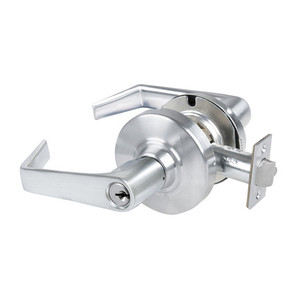
ANSI/BHMA Grade 1 is the specification standard for commercial door hardware on high-traffic and high-security openings. Cylindrical lever locks must withstand a minimum of 250,000 cycles and mortise locks are tested to 500,000 cycles. Grade 1 hardware is required by most commercial building codes, IBC occupancy categories, and institutional project specifications.
All specification-grade brands stocked by National Lock Supply, including Schlage, Von Duprin, Sargent, Corbin Russwin, LCN, and Adams Rite, manufacture exclusively to Grade 1 standards. ANSI/BHMA certification documentation is available on request for project submittals.
The Americans with Disabilities Act (ADA) and ICC A117.1 establish hardware requirements for accessible commercial entrances and interior openings. Compliant hardware must be operable with one hand without tight grasping or twisting, require no more than 5 lbf of force to operate, and be mounted between 34 and 48 inches above finished floor.
Lever handles are required on all accessible openings since round knobs do not comply. Surface-mounted door closers with adjustable spring tension are the most commonly specified ADA closing solution. Low-energy automatic operators eliminate the force requirement entirely and are preferred in healthcare, education, and high-volume public entrances.
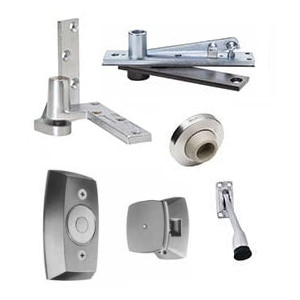
For door assemblies requiring full accessibility, kick plates and mop plates, door stops and holders, and architectural door trim must also comply with height and operability requirements under ICC A117.1.
DUMMY
Fire-rated door assemblies require hardware listed by UL or another approved agency in accordance with NFPA 80. The hardware listing must correspond to the fire rating of the door assembly: 20-minute, 45-minute, 60-minute, or 90-minute. Each component of the opening requires independent UL listing, covering the lockset, door closer, hinges, and exit device.
Positive-latching hardware is mandatory on all fire-rated openings. Deadbolts and latches and strikes must engage automatically without manual operation. Self-closing mechanisms are required, with surface door closers and spring hinges being the two most common solutions.
For storefront glass door applications on fire-rated assemblies, Adams Rite deadlocks and deadlatches carry UL listing for aluminum frames. Rim exit electric strikes and mortise electric strikes are available in UL-listed configurations for fire-rated openings.
Hardware specifications vary by occupancy type, traffic volume, security requirements, and applicable codes.
Standard office applications call for Grade 1 cylindrical lever locks in office and entry functions, with electrified cylindrical or mortise locks at access-controlled entries. Storefront deadlatches handle aluminum glass entry doors and electronic keypad locks replace mechanical locksets at server rooms and secure areas.
School security specifications require classroom cylindrical lever locks that can be locked from inside without a key, which is critical for lockdown protocols. Panic exit devices are required on all egress doors per IBC and surface door closers with delayed action are specified on accessible routes and high-traffic corridors.
Healthcare door hardware must balance infection control, accessibility, and security. Low-energy power operators are specified at entries to patient areas and operating rooms to eliminate touchpoints. Electrified mortise locks integrate with nurse call and access control systems and continuous hinges replace standard butt hinges on heavy-use patient room doors.
Aluminum storefront glass doors require specialized hardware. Adams Rite deadlocks and deadlatches are the industry standard for aluminum frame glass doors, with storefront trims providing pull handle and thumb-turn function. Floor-concealed door closers are preferred in retail for their clean appearance on glass entries.
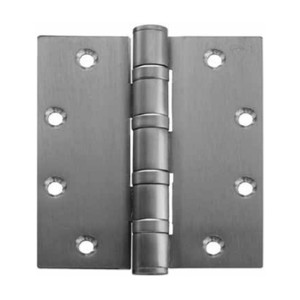
High-cycle industrial environments require the heaviest-duty hardware available. Heavy-duty mortise locks handle the highest traffic in storeroom and entrance functions and panic exit devices are the standard specification for warehouse egress. Security hinges with non-removable pins are specified on outswing exterior doors.
Stairwell egress doors use panic exit devices on the egress side and exit device trims for re-entry control. Lobby entries integrate cylindrical electric strikes or electromagnetic locks with intercom systems and unit doors use cylindrical lever locks in apartment function.