 SAME DAY & EXPEDITED SHIPPING AVAILABLE






Mechanical Locks
Mechanical locks are key- and lever-operated locksets that work without power, and they are on most commercial doors. Shop mortise locks, cylindrical lever locks, cylindrical knob locks, commercial deadbolts and latches, strikes and parts from Schlage, Falcon, Corbin Russwin, Arrow, Accentra (Yale), Sargent, BEST and Dexter.
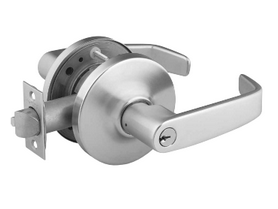


Types of commercial mechanical locks
Commercial mechanical locks fall into a few types, and the door prep usually decides which one you need. A mortise lock fits a rectangular pocket cut into the door edge. A cylindrical (bored) lock fits a round hole through the door face and a smaller hole in the edge. A deadbolt adds a separate bolt, and auxiliary rim locks mount on the inside face. Keyless mechanical pushbutton locks are a separate group; see mechanical pushbutton locks.
| Lock type | Door prep | ANSI/BHMA standard | Typical use |
|---|---|---|---|
| Mortise lock | Pocket in the door edge | A156.13 | Heavy traffic, institutional, entrances |
| Cylindrical lever lock | Bored hole, standard backset | A156.2 | Offices, classrooms, interior and exterior doors |
| Cylindrical knob lock | Bored hole | A156.2 | Matching existing knob hardware |
| Deadbolt | Bored hole or mortise pocket | See series | Added security on swing doors |
| Auxiliary rim lock | Surface mounted | See series | Second lock without new boring |
Mortise vs cylindrical locks
Choose a mortise lock for the heaviest traffic and for doors already prepared for one, and a cylindrical lock for standard bored doors where faster installation matters. Mortise locks hold the latch, the deadbolt and the function mechanism in one case inside the door, and series such as the Falcon MA, Schlage L, Sargent 8200 and BEST 45H are listed as Grade 1. Cylindrical locks install through two holes and come in Grade 1 and Grade 2 series, such as the Schlage ND, Falcon TM and Sargent 10X Line. Changing from one type to the other usually means new door prep or a wrap around plate.
Lock functions: passage, privacy, office, storeroom and classroom
The function is what the lock does, and it is the most important choice after the type. Common commercial functions are:
- Passage: both levers always free, no locking.
- Privacy: locked from inside with a button or turn, with an emergency release outside.
- Office or entry: locked by a button or turn inside, opened by key outside.
- Storeroom: outside lever always locked, key outside, inside always free.
- Classroom: outside lever locked or unlocked by key from the outside; classroom security (intruder) functions lock from inside with a key.
Most series also offer dormitory, apartment, hotel and exit functions. Each manufacturer uses its own function codes, so match the code in the listing.
Grade 1 vs Grade 2 mechanical locks
ANSI/BHMA grades rate a lock's strength and cycle life: Grade 1 for heavy duty and Grade 2 for medium duty. Specify Grade 1 for exterior doors, schools, hospitals and high-traffic openings, and Grade 2 for lighter interior use. Our category names show the grade of each series, for example the Arrow QL Series (Grade 1) and the Arrow RL Series (Grade 2). Our Grade 1 lock hardware guide explains the testing.
Cylinders, cores and key systems
Most mechanical locks are ordered with a conventional cylinder, less cylinder, or prepared for an interchangeable core (SFIC, LFIC or FSIC). If the building has a master key system, match the core type and keyway before ordering, and order cylinders or cores separately where the lock is sold less cylinder. See cylinders, cores and key blanks.
Levers, ADA and door prep
Lever trim is the usual choice on accessible routes, because levers can be operated without tight grasping or twisting, as the ADA 2010 Standards (309.4) require for operable parts. Before ordering, confirm the door thickness, backset (2-3/8" or 2-3/4" on most cylindrical locks), hand where the lever is handed, and strike type. Replacement latches, strikes and parts are in latches, strikes and parts.
Most requested mechanical locks
The mechanical locks our customers look up most often right now:
- Falcon D271 Thumbturn x Occupancy Indicator Deadbolt
- Schlage B560 IS-OCC Single Cylinder Deadbolt with indicator
- Schlage ND40S RHO OS-OCC Privacy Lever Lock with indicator
Related categories: electrified locks, exit hardware and storefront bolts and latches.
What to have ready when ordering a mechanical lock
- Lock type (mortise or cylindrical) and existing door prep.
- Function and grade from the door hardware schedule.
- Lever or knob style, and hand if handed.
- Cylinder or core type and keyway.
- Door thickness, backset, strike and finish (for example 626 satin chrome).
Specifying a building? Request a quote for project pricing, and schools and agencies can submit a government or school PO. Orders placed before 3:00 p.m. ET on business days ship the same day after card approval, and ground shipping is free on orders of $450+. Call 718-814-6300 with your hardware schedule.
The tables and selection notes on this page are compiled by National Lock Supply from manufacturer catalogs and product listings. Last reviewed: November 2026.
Frequently Asked Questions
What is the best mechanical door lock for a commercial door?
The right lock depends on the door. For heavy traffic or exterior doors, a Grade 1 mortise or cylindrical lock in the correct function is the usual choice. For light interior doors, Grade 2 may be enough. Match the function, grade, key system and door prep.
Do mechanical locks need power or batteries?
No. A mechanical lock is operated by a key, thumbturn, lever or pushbutton combination and needs no power, which is the main difference from electrified locks and electronic keypad locks. That makes mechanical locks simple to install and maintain, with no wiring or batteries to replace.
What is the most secure type of mechanical lock?
For commercial doors, a Grade 1 mortise lock or Grade 1 deadbolt with a restricted or high security cylinder gives the most resistance and the most key control. Security also depends on the door, frame and strike, so a strong lock on a weak frame or with a short strike will still be the weak point.