 SAME DAY & EXPEDITED SHIPPING AVAILABLE






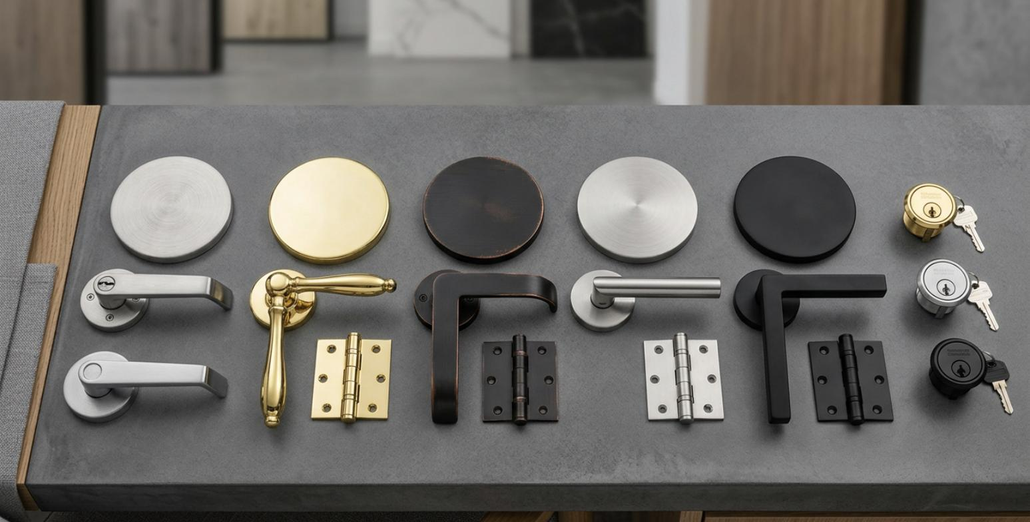
Door Hardware Finishes Guide BHMA Codes 605-630 and US Equivalents
Posted by National Lock Supply on Jun 7th 2026
Every commercial hardware order requires a finish code, and there are two systems still in use. The older US numbering (US3, US26D, US10B) and the BHMA/ANSI A156.18 codes that replaced it (605, 626, 613) describe the same finishes, but the BHMA code is the current standard while the US code is the legacy shorthand most of the trade still speaks. The two finishes you will order most are 626 (satin chrome, formerly US26D) for interior commercial hardware and 630 (satin stainless steel, formerly US32D) for exit devices, hinges, and exterior or coastal hardware. This guide gives the full translation table, explains the base-material codes, and shows how to keep a finish consistent across closers, locks, hinges, and exit devices that come from different manufacturers.
Why there are two code systems
The US numbering system dates to early twentieth-century hardware catalogs. ANSI/BHMA A156.18 modernized it into a three-digit code that also encodes the base metal. The industry now specifies BHMA codes officially, but locksmiths, distributors, and many price books still cross-reference the US equivalent. A correct spec uses the BHMA code and may note the US code in parentheses, for example 626 (US26D). A156.18 is the finishes standard within the broader hardware family, and for the full standards map see the BHMA A156 series cheat sheet.
The finish translation table
This table translates every common BHMA code to its US equivalent, names the finish, and shows where it typically belongs.
| BHMA | US equivalent | Finish | Typical use |
|---|---|---|---|
| 605 | US3 | Bright brass | Decorative, traditional interiors |
| 606 | US4 | Satin brass | Decorative interiors |
| 612 | US10 | Satin bronze | Architectural, traditional |
| 613 | US10B | Oil-rubbed bronze (dark) | High-design interiors, hospitality |
| 618 | US14 | Bright nickel | Decorative |
| 619 | US15 | Satin nickel | Residential-leaning commercial |
| 622 | US19 | Flat black (painted) | Budget, industrial, black-spec design |
| 625 | US26 | Bright chrome | Polished commercial |
| 626 | US26D | Satin chrome | Most common interior commercial |
| 628 | US28 | Satin aluminum (clear anodized) | Aluminum storefront, closers |
| 629 | US32 | Bright stainless steel | Polished exterior, high-traffic |
| 630 | US32D | Satin stainless steel | Exit devices, hinges, exterior, coastal |
| 643e | US10BE | Dark oxidized bronze, equivalent | Living-finish look without solid bronze |
| 689 | (none) | Aluminum painted (sprayed) | Door closers, economy |
| 690 | (none) | Dark bronze painted | Closers, exterior trim |
| 695 | (none) | Dark bronze powder coat | Closers |
626 and 630 cover the majority of commercial orders. 626 (satin chrome) is the default interior finish for locksets and trim, while 630 (satin stainless steel) is the default for exit devices, hinges, and anything exterior or coastal, because stainless resists corrosion far better than plated chrome. For example, a BEST 45H Grade 1 office mortise lock in 630 satin stainless carries the finish in the base metal rather than in a plating.
How the base-material digit works in BHMA codes
A156.18 codes encode the base metal in the way the finish is applied, which is why two finishes can look identical but wear very differently. One may be plated brass and the other solid stainless. The practical rules:
- 626 is satin chrome plated over brass or bronze. It offers good interior durability but lower corrosion resistance outdoors.
- 630 is satin stainless steel, where the finish is the base metal. It has the best corrosion resistance and is the right call for exterior, pool, coastal, and food-service environments.
- 628 is clear-anodized aluminum, standard on aluminum storefront hardware and many door closers.
- 689, 690, and 695 are painted or powder-coated finishes used mostly on door closers, where a sprayed finish over the cast body is normal and cost-effective.
For coastal and high-corrosion environments, default to 630 stainless. See how to choose storefront hardware for aluminum doors for the 628 storefront context and the corrosion discussion. The 630 corrosion rule is applied in restaurant and food service door hardware and hurricane and impact-rated hardware for Florida.
Matching finishes across mixed-brand openings
A single opening often carries a lock from one manufacturer, a closer from another, hinges from a third, and an exit device from a fourth. Each names its finish the same way (BHMA/US), so the codes match across brands, but two cautions apply:
- Closers use painted codes (689, 690, 695), not 626 or 630. A 626 lock paired with a 689 aluminum-painted closer will not match in tone. To match a satin-chrome opening, order the closer in a sprayed finish that approximates 626, or accept the closer as a deliberately neutral element. See how to choose a commercial door closer.
- Living finishes (613 oil-rubbed bronze, 612 bronze) change over time. They are not stable and they patina with handling. Specify 643e or a coated equivalent if a stable dark look is required.
Browse finishes by brand on LCN, Norton, and Von Duprin, and on the door closers, door hinges, and panic exit devices category pages.
When the design spec overrides the default
Architectural specs sometimes call for decorative finishes (613 oil-rubbed bronze, 605 bright brass, 622 flat black) on visible public-facing hardware while keeping 626 or 630 on back-of-house doors. The rule is simple: match the visible finish to the design intent, and use the durable default (626 interior, 630 exterior) everywhere the public does not see. Flat black (622) is increasingly specified in modern design, but it is a painted finish that shows wear at high-touch points faster than 630.
Common finish-spec mistakes
- Specifying 626 on exterior or coastal doors. Plated chrome corrodes outdoors. Use 630 stainless instead.
- Expecting a closer to match a lock exactly. Closers use painted codes, so plan the tone deliberately.
- Mixing US and BHMA codes without translating. US26D and 626 are the same, but 626 and 630 are not. Confirm before ordering a full opening.
- Choosing a living finish where a stable look is required. Oil-rubbed bronze patinas, so specify a coated equivalent for consistency.
- Forgetting finish on accessory hardware. Strike plates, flush bolts, coordinators, and thresholds all carry finish codes and should match the opening.
Finish durability: plated, PVD, and powder-coat
A BHMA code names the color and the base material, but it does not tell you how the finish is applied, and that is what decides how long it lasts. A standard plated finish such as 626 satin chrome is electroplated over a brass or bronze base, and it wears gradually at high-touch points. A PVD finish, short for physical vapor deposition, bonds the color at a molecular level in a vacuum chamber, which produces a far harder and more tarnish-resistant surface. PVD is the reason a lifetime brass (605-equivalent) lever can keep its color in a coastal or heavy-traffic setting where ordinary plating would dull. Black hardware and matte black, by contrast, are usually a powder-coat or PVD layer rather than a plating, so the 622 or 315 code should be read together with the coating method before you commit a whole opening to it.
Specialty finishes: antimicrobial and high-wear
Two specialty categories matter in healthcare, food service, and senior living. Antimicrobial finishes, often a silver-ion or copper-based treatment layered onto the standard finish, reduce surface bacteria on levers, push plates, and pulls that get constant hand contact. High-wear coatings, including thicker PVD and clear-coated living finishes, are specified where the maintenance budget will not tolerate refinishing. When you write the spec, the finish suffix and any antimicrobial or coating callout should travel with the BHMA number, because two levers can share a 626 code and still behave very differently in service.
FAQ
What is the most common commercial door hardware finish?
626 (satin chrome, US26D) for interior locksets and trim, and 630 (satin stainless steel, US32D) for exit devices, hinges, and exterior hardware. Together they cover most commercial orders.
What is the difference between 626 and 630?
626 is satin chrome plated over brass or bronze and is best for interior use, while 630 is satin stainless steel with far better corrosion resistance for exterior, coastal, and food-service environments.
Why do door closers have different finish codes?
Closer bodies are cast and sprayed, so they use painted codes (689 aluminum, 690 and 695 dark bronze) rather than the plated 626 or 630 used on locks. Plan the tone match deliberately.
Is US32D the same as 630?
Yes. US32D is the legacy code and 630 is the current BHMA/ANSI A156.18 code for satin stainless steel. Specs may write 630 (US32D).
Do accessory items need a finish code too?
Yes. Strike plates, flush bolts, coordinators, thresholds, and trim all carry finish codes, and matching them to the opening keeps the whole door visually consistent.
Next step
Pick the finish at the same time as the function: 626 for interior locksets, 630 for exit devices, hinges, and anything exterior or coastal, and a matching sprayed code for closers. Confirm finish availability per product on the door closers, door hinges, panic exit devices, and cylindrical lever locks category pages. Our commercial desk confirms finish codes across every brand on an opening so the lock, closer, hinge, and exit device ship in matching tones.