 SAME DAY & EXPEDITED SHIPPING AVAILABLE






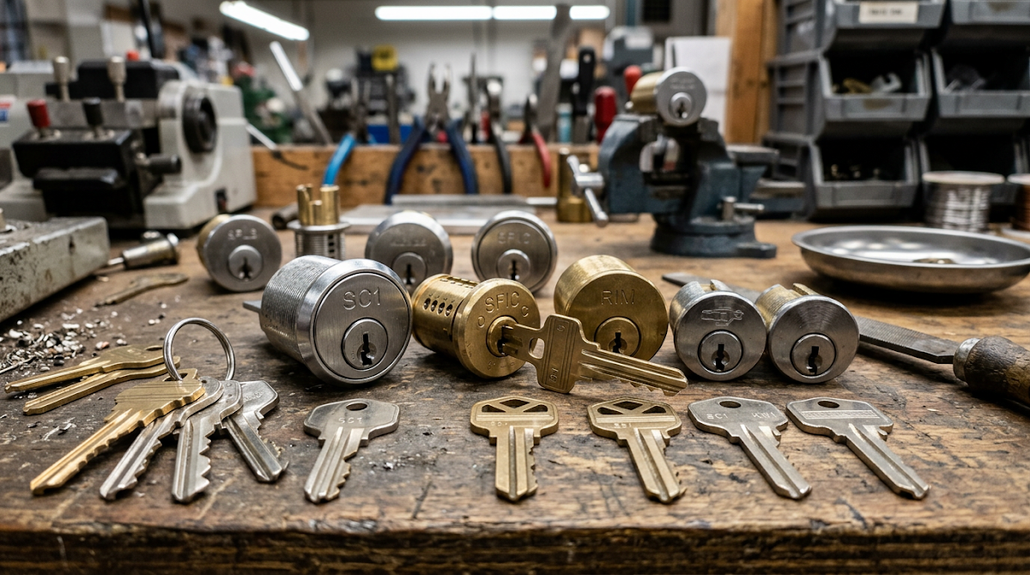
Commercial Cylinder Keyways and Keying Compatibility
Posted by National Lock Supply on Jun 4th 2026
A keyway is the shaped slot a key blank fits into, and it is the single factor that decides which cylinders can share a key. The keyway is what lets a key turn a lock at all, while the pinning inside the cylinder is what makes it the right key. Commercial keying really comes down to three decisions made in order: the keyway family (Schlage C, Sargent LA, Corbin Russwin 59/60, Yale, or a high-security keyway), the cylinder format (standard mortise, rim, or key-in-lever, or an interchangeable core in SFIC or LFIC), and the keying scheme (keyed alike, keyed different, or master keyed). To keep one key working across a building, every cylinder has to share a keyway family and be pinned to the same system. This guide explains the major keyway families, the interchangeable-core formats, and how to keep a whole portfolio on one key plan without trapping yourself with a single supplier.
Keyways versus pinning: the core idea
A Schlage C key physically will not enter a Sargent LA cylinder, because the profiles differ. That is why the first rule of any keying project is to pick one keyway family per system. Mixing keyways means mixing key rings, which defeats the entire purpose of master keying. Standard commercial keyways are open or conventional, meaning blanks are widely available and any locksmith can cut them. High-security keyways such as Medeco, Mul-T-Lock, ASSA, and Schlage Primus are restricted or patented, so the blanks are controlled and keys cannot be copied at a hardware store. For the high-security comparison, see Medeco vs Mul-T-Lock vs ASSA high-security cylinders.
The major commercial keyway families
Most commercial work in the US falls into a handful of keyway families. The table below summarizes who uses each one, how easy the blanks are to get, and where each one fits best.
| Keyway family | Brands using it | Blank availability | Typical use |
|---|---|---|---|
| Schlage C / Classic | Schlage, many aftermarket | Very wide (open) | Most common US commercial |
| Sargent LA / RA | Sargent | Wide | Sargent-spec buildings |
| Corbin Russwin 59A1 / 60 | Corbin Russwin | Wide | CR-spec buildings |
| Yale (GA, etc.) | Yale | Wide | Yale-spec buildings |
| High-security restricted (UL 437) | Medeco, Mul-T-Lock, ASSA, each proprietary | Restricted, dealer-controlled | High-security, audit-grade key control |
Schlage C is the de facto default for general commercial work because blanks and cylinders are everywhere and most aftermarket cylinders offer a Schlage C option. Choose a restricted keyway only when unauthorized key duplication is the specific threat you are defending against. Browse cylinders and blanks on the cylinders, cores, and key blanks category page.
Interchangeable cores: SFIC and LFIC change everything
An interchangeable core (IC) is a self-contained cylinder that drops in and out of a housing with a control key, without disassembling the lock. There are two formats, and they do not interchange with each other:
- SFIC (Small Format Interchangeable Core): the figure-8 core, an open industry format used by many brands. Cores and housings are widely cross-compatible, which makes SFIC the flexible choice for multi-supplier portfolios.
- LFIC (Large Format Interchangeable Core): brand-specific formats from Schlage (FSIC), Corbin Russwin, Sargent, and Medeco. They are larger, proprietary, and often carry higher-security keyways.
IC systems let a facility rekey by pulling a core in seconds instead of servicing the lock, which is exactly why large portfolios standardize on them. A lock ordered SFIC-ready, such as the Schlage L9480 storeroom mortise lock that accepts a small-format IC core, lets you drop in the building keyed core at install instead of pinning the lock itself. The trade-off is straightforward: SFIC is open and flexible, while LFIC ties you to a brand but can carry high-security keyways. This decision is covered in depth in SFIC vs LFIC interchangeable cores explained: what to buy, and the housing options in IC housings explained: mortise vs rim vs key-in-lever.
Keying schemes: alike, different, master keyed
Once the keyway is fixed, the keying scheme defines which keys open which doors:
- Keyed Alike (KA): one key opens every cylinder in the group. Used for a suite or a set of doors one person controls.
- Keyed Different (KD): every cylinder has its own key. This is the default for unrelated tenants.
- Master Keyed (MK): each door has its own change key and a master key opens all of them. Add grand-master and great-grand-master tiers for large portfolios.
A master key system is designed once and pinned consistently across every cylinder, which is the reason all cylinders must share the keyway family. See master key systems for commercial buildings for the full system-design walkthrough.
How to keep a portfolio on one system without single-supplier lock-in
The real risk in standardizing is getting trapped with one manufacturer. These mitigations keep a portfolio consistent while preserving competition among suppliers:
- Standardize on an open keyway (Schlage C) or SFIC so multiple manufacturers can supply compatible cores and cylinders.
- Keep the keying bitting and system records with the facility, not only with the locksmith, so any qualified locksmith can extend the system later.
- Use restricted keyways only where the threat justifies it, because they intentionally limit suppliers in exchange for key control. That trade-off is the point at high-security doors, as in bank and credit union door hardware and government and municipal building door hardware, but it becomes a liability when applied building-wide.
- Match the cylinder format to the lock chassis: mortise cylinders for mortise locks, rim cylinders for rim exit devices, and key-in-lever for cylindrical locks. Confirm the housing before ordering. Browse formats by brand on Schlage commercial, Sargent, and Corbin Russwin.
Common keyway and keying mistakes
- Mixing keyway families in one master system. A Schlage C master key will never operate a Sargent LA cylinder. Pick one family and stay in it.
- Ordering the wrong cylinder format. A rim cylinder will not fit a mortise lock. Confirm mortise versus rim versus key-in-lever versus IC before you buy.
- Choosing a restricted keyway building-wide for convenience. It locks you to one supplier, so reserve it for the doors that genuinely need key control.
- Not capturing the keying schedule. Without the bitting records, future rekeying and master-key extension become guesswork.
- Assuming SFIC and LFIC interchange. They do not. SFIC is the open figure-8, while LFIC is brand-specific and larger.
FAQ
What is the most common commercial keyway?
Schlage C (Classic) is the de facto default for general commercial work, because cylinders and key blanks are widely available and most aftermarket cylinders offer a Schlage C option.
What is the difference between a keyway and a keying scheme?
The keyway is the physical key and cylinder profile that determines compatibility. The keying scheme (keyed alike, keyed different, master keyed) defines which keys open which doors within a compatible keyway family.
Can I master key high-security cylinders?
Yes. Medeco, Mul-T-Lock, ASSA, and Schlage Primus all support master keying, with the added benefit of restricted blanks so keys cannot be copied without authorization. The system has to stay within one high-security family.
Should I choose SFIC or LFIC?
SFIC is an open, flexible figure-8 format that suits multi-supplier portfolios, while LFIC is brand-specific and larger and often carries higher-security keyways. See the SFIC vs LFIC guide for the full decision.
How many doors can one master key system cover?
A well-designed system scales from a few doors to thousands by adding grand-master and great-grand-master tiers, as long as every cylinder shares the keyway family and the bitting plan is documented and maintained.
What are the levels in a master key hierarchy?
A master key system is layered. At the bottom is the change key, which opens one door only. Above it the master key opens a group of doors, for example one floor or one department. In larger systems a grand master key opens several master-keyed groups, and a great grand master sits above that for a campus or a multi-building portfolio. Planning these levels on paper first, before any cylinder is pinned, is what keeps the system expandable without a full rekey later.
Next step
Fix the keyway family first, then the cylinder format, then the keying scheme. For general commercial work, Schlage C or SFIC keeps the system open and supplier-flexible, so reserve restricted keyways for the doors that need true key control. Start from the cylinders, cores, and key blanks category and confirm the cylinder format against your lock chassis. Our commercial desk designs and pins master-key systems and matches cylinders across Schlage, Sargent, Corbin Russwin, Yale, and SFIC so one key plan covers the whole portfolio.