 SAME DAY & EXPEDITED SHIPPING AVAILABLE






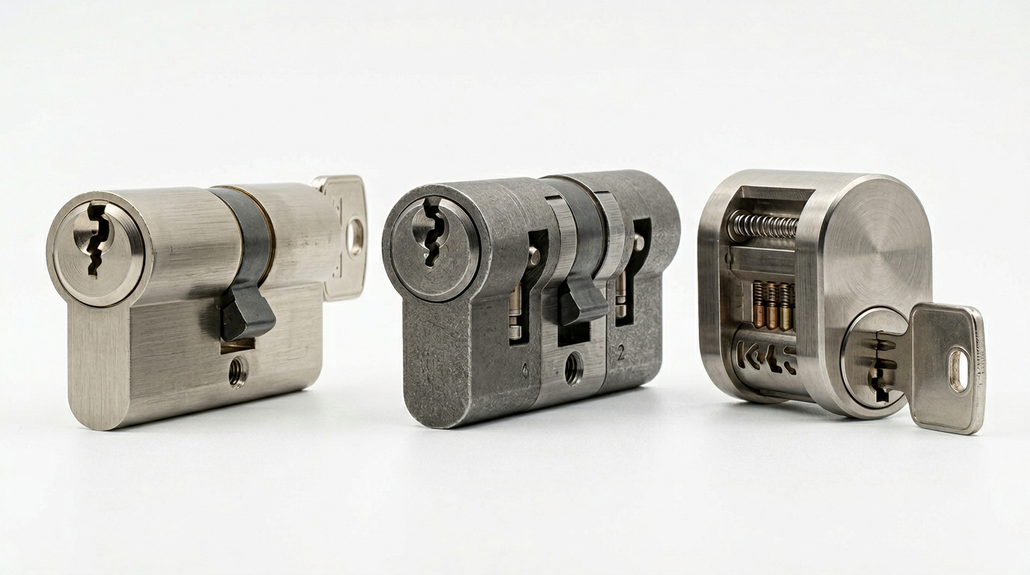
Medeco vs Mul-T-Lock vs ASSA: High-Security Cylinders
Posted by National Lock Supply on Apr 15th 2026
A high-security lock cylinder is a drop-in cylinder replacement that upgrades a commercial lock body with pick resistance, drill resistance, and restricted key-control — without replacing the lock body itself. The three brands that dominate the U.S. high-security cylinder market are Medeco (ASSA ABLOY), Mul-T-Lock (ASSA ABLOY), and ASSA (also ASSA ABLOY, same parent company, different product line). All three carry UL 437 listing for attack resistance. All three use restricted keyways that cannot be duplicated at a hardware store. They differ in keyway geometry, attack profile, key-control administration, and price tier. This guide explains how to choose between them when upgrading an existing commercial door without replacing the lock.
Before upgrading cylinders, verify the lock body itself is worth keeping. A Grade 3 residential lock body is not improved by a high-security cylinder — you are upgrading the cheapest part of a weak chain. For the lock-assessment framework, read How to Assess the Security of Your Locks and Mistakes to Avoid When Buying Door Locks. For the broader “what’s worth upgrading” conversation, Top 3 Most Trusted Brands for Door Locks is the starting point.
Quick verdict
- Medeco → the North American institutional standard for high-security cylinders. Rotating-pin design, broadest retrofit kit availability, strongest presence on federal and government specifications. Default choice for U.S. commercial retrofits.
- Mul-T-Lock → the pin-in-pin telescopic design with the strongest pick resistance and a strong international presence. Default when the building owner wants the hardest-to-pick cylinder and key-control is managed directly by a dealer.
- ASSA → the interactive side-pin design with exceptional drill and bump resistance. Most specified on European-influenced projects and on high-consequence targets (data centers, pharmaceutical, legal).
All three are UL 437 listed. All three are available in mortise, rim, and key-in-lever (KIL) formats. All three have restricted keyways that require a signed authorization from a registered end-user before a duplicate key is cut. Pick among them based on the retrofit target (what lock body the cylinder is going into), key-control administration, and threat model.
Entity attributes side-by-side
|
Attribute |
Medeco |
Mul-T-Lock |
ASSA |
|---|---|---|---|
|
Parent company |
ASSA ABLOY |
ASSA ABLOY |
ASSA ABLOY |
|
Flagship cylinder line |
Medeco³ / Medeco M³ / X4 |
MT5+ / Interactive+ |
Twin 6000 / Twin Maximum |
|
UL 437 listing |
Yes |
Yes |
Yes |
|
BHMA grade |
Grade 1 |
Grade 1 |
Grade 1 |
|
Attack resistance |
Rotating pin + angled cuts + side bar |
Pin-in-pin telescopic + alpha spring |
Side bar + interactive key element |
|
Pick resistance |
Very high |
Highest (most expert picks fail) |
Very high |
|
Drill resistance |
Hardened inserts |
Hardened inserts |
Hardened inserts + anti-drill plate |
|
Bump resistance |
High |
High |
Highest |
|
Key control |
Patent-protected, restricted blanks, signature required |
Patent-protected, dealer-administered |
Patent-protected, dealer-administered |
|
Keyway compatibility |
Medeco retrofit catalog |
Mul-T-Lock retrofit catalog |
ASSA retrofit catalog |
|
Retrofit formats |
Mortise, rim, KIL, SFIC, deadbolt, padlock |
Mortise, rim, KIL, SFIC, deadbolt, padlock |
Mortise, rim, KIL, SFIC, deadbolt, padlock |
|
Typical price tier |
Mid-premium |
Premium |
Premium |
|
Best for |
Broad U.S. commercial retrofit |
Highest-pick-resistance requirement |
Data center / pharma / legal |
The common denominator across all three: they install into the same lock body you already own (assuming the body accepts a standard mortise, rim, or KIL cylinder format). You are not replacing the Schlage L9000, Sargent 8200, or Corbin ML2000 — you are swapping the cylinder inside it. For the broader mortise-lock-body context, see our Schlage L9000 vs Sargent 8200 vs Corbin ML2000 comparison.
Medeco: the North American institutional default
Medeco is the most specified high-security cylinder brand in U.S. commercial and institutional construction. The flagship line — Medeco³ (M³), and the newer Medeco X4 — uses a rotating pin design that requires the key to both lift the pins to the correct height and rotate them to the correct angle before the side bar releases. Standard picks can lift; they cannot also rotate. This is the attack-resistance innovation that built Medeco’s reputation.
Choose Medeco when:
- The building is on a federal, state, or municipal specification — Medeco has the deepest bench on government spec.
- You need the widest retrofit catalog — Medeco publishes cylinder retrofits for virtually every major U.S. commercial lock body, including Schlage, Sargent, Corbin Russwin, Yale, Best, Arrow, and Adams Rite.
- The building owner wants a nationally recognized brand for liability and insurance conversations.
- You need a cylinder for a Schlage Primus-compatible body — Medeco’s retrofit path into Schlage L9000 is among the most deployed upgrade patterns in the U.S.
Skip Medeco when:
- The owner has done their research and specifically wants the pick resistance of Mul-T-Lock MT5+.
- The project is international and Mul-T-Lock or ASSA is the local standard.
High-security cylinders are stocked across the cylinder subcategories: Mortise Cylinders for Schlage L9000 / Sargent 8200 / Corbin ML2000 retrofits, Rim Cylinders for rim exit devices, Deadbolt Cylinders for commercial deadbolt upgrades, and IC Housings for interchangeable-core conversions.
Mul-T-Lock: the hardest to pick
Mul-T-Lock uses a pin-in-pin telescopic design — each main pin has an internal pin that must also align before the cylinder rotates. The result is a pin arrangement that defeats almost every standard pick technique and most expert picks. Mul-T-Lock’s flagship MT5+ adds an alpha spring element that further complicates picking, making this the hardest-to-pick cylinder in common commercial deployment.
Choose Mul-T-Lock when:
- The threat model explicitly includes skilled lock picking as a concern — rare on retail or office, meaningful on jewelry stores, art storage, cannabis dispensaries, and high-value storage.
- The building owner wants a direct dealer relationship for key control — Mul-T-Lock administers key control through authorized dealers with geographic exclusivity, which means duplicate keys cannot be cut anywhere other than the specific dealer assigned to the account.
- The project is international or the owner has a Mul-T-Lock preference from another building.
Skip Mul-T-Lock when:
- The retrofit target is a lock body that is not on the Mul-T-Lock retrofit catalog (most major U.S. bodies are, but confirm first).
- The owner wants the most recognized brand for insurance purposes — Medeco has stronger name recognition in the U.S.
ASSA: the side-pin engineering standard
ASSA (the brand, not the parent company) uses an interactive side-pin design with a side-bar release. The ASSA Twin 6000 and Twin Maximum cylinders combine extreme drill resistance, very high bump resistance, and a key-control system that is administered through registered ASSA dealers. ASSA is especially strong on drill attacks thanks to a dedicated anti-drill plate in the front of the cylinder.
Choose ASSA when:
- The threat model includes drilling and destructive attack — data center rooms, pharmaceutical storage, evidence rooms, legal document storage.
- The project is on an ASSA ABLOY commercial submittal and the hardware is already Sargent or Corbin Russwin — ASSA cylinders are the natural upgrade path within the same family.
- The building is European-influenced in spec (ASSA has stronger European heritage than Medeco).
Skip ASSA when:
- The retrofit is on a Schlage body — Medeco’s Schlage retrofit path is more direct.
- The owner wants the broadest stock availability in the U.S. — Medeco has the deepest distribution.
What “retrofit” actually means
A cylinder retrofit is not a lock replacement. You are:
- Removing the existing cylinder from the lock body (cam screw, set screw, or side screw depending on the lock).
- Inserting the new high-security cylinder with the matching cam for that specific lock body.
- Re-torquing the set screw.
- Cutting new keys on the restricted blank.
Total labor per door is typically 5–15 minutes once the right cylinder is in hand. The entire upgrade happens without touching the lock body, the trim, the strike, or the door prep. This is why cylinder retrofit is the fastest and most cost-effective security upgrade on an existing commercial building.
The critical spec detail is the cam: different lock bodies (Schlage mortise, Sargent mortise, Corbin Russwin mortise, Adams Rite storefront, Yale, Best, Arrow) use different cam shapes. Order the cylinder with the cam that matches your specific lock body, or the cylinder will install but the bolt will not retract.
For the SFIC and LFIC variants of this same retrofit path, see SFIC vs LFIC Interchangeable Cores Explained. For the IC housing framework, IC Housings Explained: Mortise vs Rim vs Key-in-Lever walks through the compatibility matrix.
Key control: the real reason to upgrade
Most commercial break-ins on keyed doors are not picked. They are entered with a key that was copied at a hardware store or kept by a former employee. Restricted keyways fix this by legally and physically preventing key duplication:
- Legally: the keyway is patented. A key copy requires a signed authorization from the registered end-user.
- Physically: the key blanks are not sold to hardware stores or locksmiths outside the dealer network. A walk-up key duplicator cannot cut the blank even if they wanted to.
This single feature is usually more valuable than the pick or drill resistance, because it eliminates the most common attack vector (unauthorized key copies). For the “when do I rekey vs replace” decision on holidays and personnel turnover, see Holiday Shutdown Security: Core Swap, Rekey, or Keyless.
Decision matrix by threat and retrofit target
|
Situation |
Choose |
|---|---|
|
Standard U.S. commercial retrofit on Schlage body |
Medeco |
|
Federal / government spec |
Medeco |
|
Pharmacy, dispensary, jewelry, art storage |
Mul-T-Lock MT5+ |
|
Data center, evidence room, pharmaceutical |
ASSA Twin Maximum |
|
Retrofit on Sargent or Corbin body (brand consistency) |
ASSA |
|
International building or ASSA preference |
ASSA |
|
Sole concern is “nobody can copy the key” |
Any of the three — all have restricted keys |
|
Lowest cost high-security upgrade |
Medeco Classic or Medeco X4 entry line |
FAQ
Can I put a high-security cylinder in any lock? Usually yes, if the lock body accepts a standard cylinder format (mortise, rim, KIL). Confirm cam compatibility for your specific lock body before ordering.
How long does a cylinder retrofit take per door? 5 to 15 minutes of labor per opening, once the correct cylinder is in hand.
Will the new cylinder match my existing keys? No. High-security cylinders require new keys cut on restricted blanks. You will need to rekey everyone on the new system.
Is a high-security cylinder worth it on a Grade 3 residential lock? No. Upgrade the lock body to Grade 1 before spending on a high-security cylinder.
Can I master-key a high-security system? Yes. All three brands support master-keying through the dealer. You need a registered end-user agreement on file.
What about bump keys? All three brands defeat bump keys through either side-bar, pin-in-pin, or interactive-element designs. Standard commercial cylinders are bump-vulnerable — this is one of the core reasons to upgrade.