 SAME DAY & EXPEDITED SHIPPING AVAILABLE






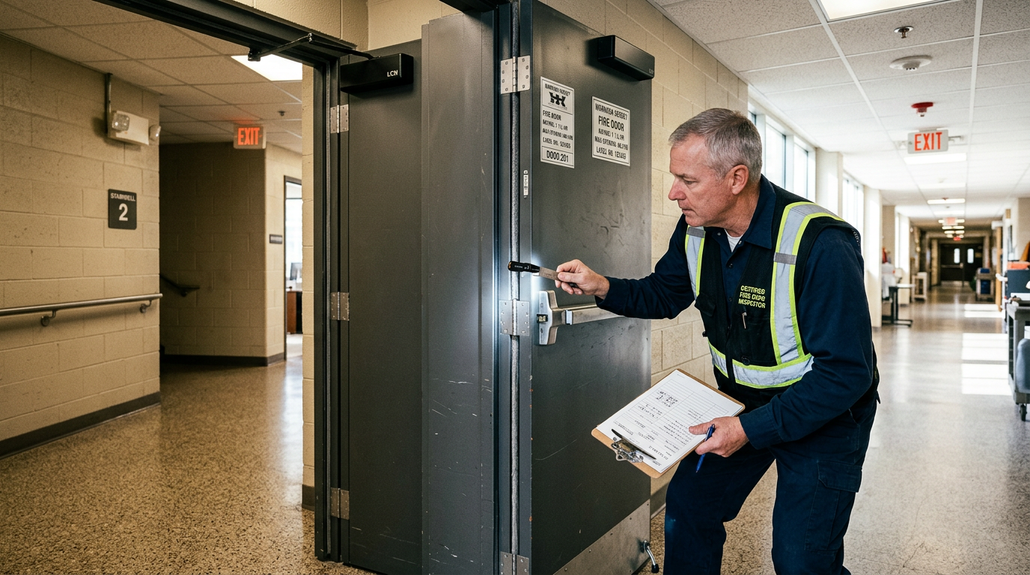
NFPA 80 Annual Fire Door Inspection
Posted by National Lock Supply on May 20th 2026
NFPA 80 requires every fire-rated door assembly in a commercial building to be inspected annually by a qualified person. The inspection covers 13 items defined in Chapter 5: labels, gaps, hardware, glazing, frame, latch, closer, signage, and field modifications. Deficiencies must be repaired without delay. Some require the door out of service immediately (missing latch, unrated hardware on a rated opening). Others have weeks. The penalty for skipping the inspection is not from NFPA itself, but from the AHJ (Authority Having Jurisdiction), insurance carrier, and Joint Commission audit on healthcare facilities. The cost of replacing one missed deficient door after a fire dwarfs the entire inspection program.
What NFPA 80 requires every year
NFPA 80 Section 5.2 (2019 edition) mandates an annual inspection of every fire-rated door and frame, plus a functional test that confirms the door closes and latches under its own closer. The inspection must be documented and the record retained for the AHJ.
Three things the inspector verifies:
- The door assembly carries valid labels (door, frame, hardware).
- The 13 visual and functional checks pass.
- Any deficiencies are documented with a planned repair date and severity.
The qualified person can be in-house staff if trained, but most facilities contract a third-party inspector who carries E&O insurance and produces a defensible report. NFPA 80 does not specify a certification, but DHI (Door and Hardware Institute) FDAI certification is the accepted credential.
The 13-point inspection checklist
Each item is from NFPA 80 Section 5.2.4. Below is the inspector's literal checklist.
- Labels are clearly visible and legible. Door label, frame label, hardware labels. A painted-over label invalidates the rating.
- No open holes or breaks in door or frame. Holes from old hardware that were not properly filled with intumescent material count as failures.
- Glazing, vision lights, glazing beads, and glazing materials are intact and securely fastened. Cracked wire glass is a fail. Plastic glazing is a fail unless rated.
- Door, frame, hinges, hardware, and noncombustible threshold are secured, aligned, and in working order with no visible signs of damage.
- No parts are missing or broken.
- Door clearances at the door edge to the frame on the pull side are no more than 1/8" plus or minus 1/16". Top: 1/8". Bottom: 3/4" max for non-rated rooms, 3/8" for rooms with low-flame-spread floor coverings.
- The door closer is operational, with no leaks, and the door fully closes when operated from the full open position.
- The coordinator on a pair of doors operates so the inactive leaf closes before the active leaf.
- The latching hardware operates and secures the door when in the closed position.
- Auxiliary hardware items that interfere or prohibit operation are not installed. Wedges, kickdown holders without electromagnetic release, deadbolts that lock the leaf closed.
- No field modifications to the door assembly that void the label. Holes for kits, retrofits, or wireless lock cutouts that were not done at a UL-listed shop.
- Gasketing and edge seals, where required, are inspected to verify their presence and integrity.
- Signage affixed to a door meets the requirements of 4.1.4. Signs must be attached with adhesive only, not screwed through the door.
The functional test
After the visual inspection, the inspector performs the close-and-latch test:
- Open the door to its full open position (or maximum allowed by stops/restraints).
- Release the door.
- Confirm the door closes fully and the latch engages without manual assist.
If the door does not self-close and latch, it fails. The most common cause is a closer that lost spring tension or a hinge that has sagged enough to scrape the strike. For closer diagnostics, read door closer in cold weather: fix slamming and poor latching.
Top 5 deficiencies (what inspectors find most)
Across thousands of inspection reports, five deficiencies dominate.
- Failure to fully latch. Often from a sagging top hinge or under-sized closer. Repair priority: high. Replace closer or shim hinge within 30 days.
- Painted-over or missing label. Often discovered during repainting. Repair priority: high. Label replacement requires a UL-listed shop, not field replacement.
- Excessive clearance at the bottom of the door. Door has worn or carpet has been added. Repair priority: medium. Install a fire-rated door bottom or trim the door if labeling allows.
- Auxiliary hardware (door wedge, holder). Repair priority: immediate. Remove on the spot. Educate staff.
- Field modification (hole for retrofitted lock). Repair priority: critical. Door out of service until repaired by a UL-listed shop or replaced.
For closer and panic device replacements, the door closers category and panic exit devices category carry UL-listed options at multiple price points.
When the door must come out of service immediately
NFPA 80 does not list "immediate" deficiencies explicitly, but the AHJ, insurance carrier, and Joint Commission interpret these as life-safety conditions:
- No latching hardware (or latch is broken).
- Door does not self-close (closer broken or missing).
- Visible hole that breaches the door core.
- Frame is detached from the wall structure.
- Auxiliary hardware physically prevents closure (kickdown without auto-release).
Tag the door, document, and escalate to the building's life-safety lead. Replacement of the hardware piece is usually 1-3 days for stocked items, 4-12 weeks for electrified hardware.
Acceptable vs non-acceptable field modifications
NFPA 80 allows some field modifications and bars others.
Allowed:
- Hardware preparation (drilling for a new lock) only if the work is done at a UL-listed shop or under a UL-listed field modification program.
- Painting (must not cover labels).
- Re-keying cylinders (no impact on rating).
Not allowed in the field:
- Cutting a new vision light.
- Cutting for a kickplate that exceeds the listed dimensions on the label.
- Adding a glass kit not on the original label.
- Welding or grinding the door or frame.
When in doubt, the rule is: if the modification could affect the fire rating, it must be done by the door manufacturer or a UL field service program.
Recordkeeping
NFPA 80 Section 5.2.3 requires the inspection record to be retained for the AHJ.
Typical contents of a record:
- Building address and identifier.
- Inspection date and inspector name/credential.
- List of every fire-rated opening (door number, location, rating, type).
- Pass/fail per opening with deficiency description.
- Photos of deficiencies.
- Planned repair date and responsible party.
- Re-inspection date once repair is complete.
Healthcare facilities under Joint Commission must retain records for 3 years minimum. Most facility managers retain for 7 years to align with audit cycles.
Repair priority matrix
Group deficiencies into four buckets:
|
Priority |
Description |
Repair window |
Door in service? |
|
Critical |
Life-safety hardware broken/missing |
Immediate |
Tag out of service |
|
High |
Fails to latch, no label, broken closer |
24-72 hours |
Allowed if mitigations in place |
|
Medium |
Excessive clearance, worn seals, minor damage |
30 days |
Yes |
|
Low |
Cosmetic, signage compliance, painted hardware |
90 days |
Yes |
Insurance and AHJ consequences
The AHJ enforcement varies by jurisdiction, but insurance carriers are increasingly auditing fire door programs.
Three financial consequences of a non-compliant program:
- Property insurance premium increase. Major carriers (FM Global, Travelers) add 10-25% to premiums on portfolios without documented annual inspections.
- Claim denial. After a fire loss, the carrier subpoenas the inspection records. Missing records or open critical deficiencies lead to partial or full claim denial.
- AHJ red-tagging. Local fire marshal can order the building closed until specific deficiencies are repaired.
For broader compliance context across the portfolio, read ADA compliance for commercial door hardware and commercial door lock maintenance checklist.
FAQ
How often does NFPA 80 require fire door inspection? Annually, at minimum. Some occupancies (healthcare under Joint Commission) require additional functional checks at higher frequency.
Who can perform the inspection? A qualified person, defined by NFPA 80 as someone with knowledge, training, or experience in the subject. DHI FDAI certification is the de facto credential.
What if a fire door is also a security door? The fire rating still applies. Adding security hardware (electric strike, panic bar, access control) must use UL-listed components rated for the door's fire rating.
Do I need to inspect smoke doors under NFPA 80? Smoke doors are covered by NFPA 105, not NFPA 80, but the inspection process is similar. Many facilities run a combined program.
Can I repair a fire door in-house? Hardware replacement with identical or UL-listed equivalent parts is in-house allowed. Door or frame modification that affects the label is not.
Next step
If your facility has an upcoming inspection, audit the hardware first against the mortise locks and door hinges categories to confirm replacement parts are available before the inspector arrives. For pair-of-doors openings, our flush bolts and coordinators guide covers the most common deficiency type. Closers and panic devices, the two top deficiency categories, should also be cross-checked against existing inventory. Contact our commercial desk for an inspection-ready parts list against your existing door schedule.