 SAME DAY & EXPEDITED SHIPPING AVAILABLE






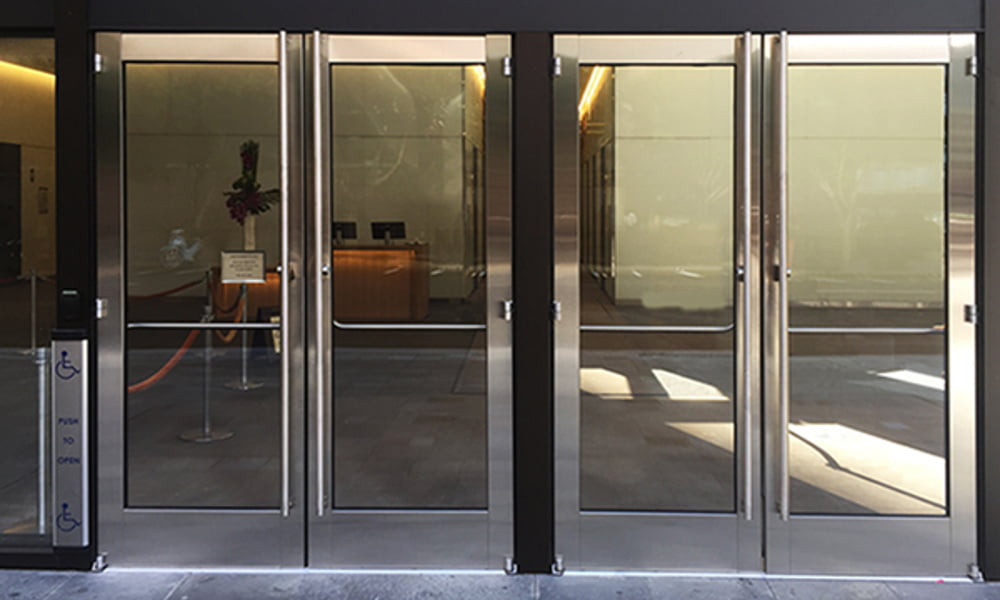
Panic Bars for Glass Storefront Doors & Gates
Posted by National Lock Supply on Apr 14th 2026
A panic bar for a glass storefront door or gate is an exit device engineered for two opening types that are structurally different from the hollow-metal doors most panic hardware is designed for: narrow-stile aluminum storefront with full-glass lites and exterior gates at assembly venues, stadiums, parks, and industrial yards. These openings have thinner stiles, no door coordinators, different strike geometries, and — in the case of gates — no frame to mount a standard exit strike. Off-the-shelf panic devices intended for hollow-metal doors will not install or will install badly. This guide explains which panic devices are designed for these two scenarios and how to spec them without failing code.
For the general panic-hardware framework, start with How to Choose the Best Commercial Panic Exit Devices and Commercial Push Bar Door Locks for Emergency Exits Guide. For the taxonomy of device types (rim, SVR, CVR, mortise), see Exit Device Types: Rim vs SVR vs Mortise vs CVR.
Quick verdict
- Glass storefront door → choose a narrow-stile rim exit device (Von Duprin 33A, 35A; Adams Rite 8800 series; Detex V40 Value). These are engineered to mount through a 1-3/4” to 2” aluminum stile without fouling the glass lite.
- Frameless glass door → choose a Von Duprin 3348A or Adams Rite 8600 with the matching glass-door mounting kit. Rare and spec-intensive — most frameless glass retail is replaced with stiled glass when panic hardware becomes a code requirement.
- Outdoor gate → choose a Detex 10 Series or Von Duprin 22 Series gate-rated panic device. These are IP-rated for outdoor exposure, come with longer rods for gate heights, and ship with a gate-specific strike.
All exit hardware on these openings must carry UL 305 panic listing if the opening is on a required egress path, and any device on a gate must match the gate frame’s structural capacity.
When you actually need a panic bar on these openings
Panic hardware is code-driven, not optional. The International Building Code (IBC) requires UL 305 panic devices on:
- Assembly occupancies with occupant load ≥50 (restaurants, theaters, classrooms, event spaces).
- Educational and daycare occupancies regardless of occupant load on certain doors.
- High-hazard (H) occupancies.
- Exits from rooms with electrical equipment rated at 1,200 amps or more.
A glass storefront door on a retail store with occupant load under 50 does not legally require a panic device — a deadlatch and lever handle are sufficient. A glass door on a 120-seat restaurant does require one, even if the frame is aluminum. Gate panic hardware is required on egress gates from assembly venues (stadiums, parks, pools), and on gates where the fenced area holds a building that would otherwise require panic hardware.
Always verify occupancy with the local AHJ before finalizing device selection.
Narrow-stile rim devices for aluminum storefront
A narrow-stile exit device is a rim-mounted panic bar with a slimmer chassis engineered to mount through an aluminum storefront stile. The standard hollow-metal exit device (Von Duprin 99, Sargent 80 series, Corbin Russwin ED4000) is too deep for most aluminum stiles — the fasteners run out of meat before they bite.
Von Duprin 33A / 35A / 3347A / 3348A
The Von Duprin 33A series is the narrow-stile sibling of the Von Duprin 99/98 family, engineered specifically for aluminum storefront and narrow-stile wood doors. The 33A is available in rim, mortise, surface vertical rod, and concealed vertical rod configurations. The 3347A and 3348A are the mortise and concealed vertical rod variants most commonly specified on single-leaf and pair openings without mullions.
Choose the 33A family when:
- The door is a narrow-stile aluminum storefront from Kawneer, YKK AP, US Aluminum, or EFCO.
- The submittal is based on the Von Duprin catalog (which it usually is in commercial spec).
- The opening needs to integrate with electric latch retraction, request-to-exit monitoring, or a card reader. The 33A accepts the same EL/QEL/RX/LX/SS options as the 99. For the electric options framework, see our Von Duprin 98 vs 99 comparison.
- The finish needs to match an existing Von Duprin hardware set.
Shop Von Duprin narrow-stile devices (33A, 35A, 3347A, 3348A) in the Panic Exit Devices category. For the matching rim strike on access-controlled openings, see Rim Exit Electric Strikes.
Adams Rite 8800 / 8600 series
The Adams Rite 8800 series is the purpose-built narrow-stile rim exit device from the same manufacturer that makes the MS1850/MS1890 storefront deadlocks and the 4710 deadlatches you likely already have on the door. Adams Rite’s strength on storefront is that the whole hardware set (deadlock, deadlatch, exit device, trim) is engineered to drop into the same stile prep without conflicts.
Choose the Adams Rite 8800 / 8600 when:
- The rest of the storefront hardware is already Adams Rite (MS1850, MS1890, 4710 deadlatch). Brand consistency reduces strike pocket conflicts.
- The opening is a retrofit where the existing prep was originally for Adams Rite.
- You want the shortest install time on a storefront opening.
Shop Adams Rite 8800 and 8600 narrow-stile exit devices in the Panic Exit Devices category. The companion storefront deadlocks and deadlatches live in Storefront Deadlocks and Storefront Deadlatches.
Detex V40 Value
The Detex V40 Value series is a cost-engineered narrow-stile rim exit device specified on openings where UL 305 panic listing is required but the building is not on a Von Duprin or Adams Rite submittal. It delivers panic compliance at a lower list price and is the right call on small-project retrofits.
Panic hardware on frameless (stiled glass) doors
True frameless glass doors — no stile at all, just tempered glass with patch fittings — cannot accept a conventional panic device. The two solutions are:
- Swap to a stiled glass door (rail top and bottom, narrow stile at the lock edge) that can accept a Von Duprin 33A or Adams Rite 8800. This is the most common code fix in a retail renovation that has become a restaurant.
- Install a gate-style pull and add a magnetic hold-open, tied to a fire alarm release. This is an alarm-system solution, not a panic-device solution, and it only works on specific occupancy types with AHJ approval.
There is no off-the-shelf panic bar that mounts to a pure frameless glass door. If your project has this condition, budget for a door replacement.
Panic hardware for gates
Gate panic hardware is a different category from door panic hardware. Gates have:
- No frame jamb — the strike is part of the gate-post assembly.
- Outdoor weather exposure — the device must be IP-rated or at minimum stainless steel.
- Larger heights — gate rods on vertical rod devices can exceed 8’.
- Different attachment hardware — through-bolts, not machine screws into a door prep.
Detex 10 Series (stadium / assembly exit)
The Detex 10 Series is the gate panic device most specified on stadium, arena, park, and pool exit gates. It is engineered for outdoor exposure, ships in stainless finishes, and includes a gate-specific rim strike that mounts to the gate post.
Choose the Detex 10 Series when:
- The gate is an assembly-occupancy egress path (stadium, arena, amusement park, public pool).
- The opening will see weather — rain, snow, UV.
- Code requires UL 305 panic listing on a gate.
Von Duprin 22 Series
The Von Duprin 22 Series is the Von Duprin gate panic device, positioned as the premium alternative to the Detex 10. It delivers the same gate-specific engineering with the Von Duprin trim catalog and finish options.
Both gate device lines are available by special request through the Panic Exit Devices category — contact NLS for gate-specific configurations not shown in the standard catalog.
Common install mistakes on these openings
- Specifying a hollow-metal exit device on aluminum storefront. The 99 or ED4000 will not mount properly on a 1-3/4” aluminum stile. Use a 33A, 8800, or V40 instead.
- Ignoring the finish match. Aluminum storefront finishes (US28, 313, black, chrome) differ from hollow-metal commercial finishes. The panic device has to match the rest of the door.
- Forgetting the rim strike. Rim exit devices ship without the strike on some SKUs — order the matching rim strike (299 for Von Duprin, matching Adams Rite or Detex strike for other brands).
- Missing the glass clearance. The latch and chassis must clear the door’s glass lite. Confirm the stile depth and the glass setback before ordering.
- Specifying a gate panic device for a door (or vice versa). They are different products.
- Skipping UL 305 verification. If the opening is on a required egress path, the device must carry the UL 305 panic label. A non-labeled device is a code violation even if it looks the same.
For more common pre-purchase pitfalls, Mistakes to Avoid When Buying Door Locks covers the broader checklist.
Trim selection on storefront exit devices
Panic devices on storefront doors typically pair with a storefront lever or paddle trim on the exterior. The trim is selected for aesthetics and for how the door is used after hours:
- Dummy trim: exit only, no outside entry. Used on emergency exits.
- Night latch: key retracts the latch from the outside. Most common on retail storefronts.
- Passage: outside lever always retracts the latch. Used on high-traffic retail entries during business hours.
For the full trim framework, see How to Choose Storefront Door Trims: Paddle vs Lever and How to Choose Exit Device Trims: Complete Guide.
FAQ
Can I put a Von Duprin 99 on an aluminum storefront door? Not properly. The 99 is designed for hollow-metal prep. Use the 33A, which is the narrow-stile sibling designed for aluminum stiles.
Do I need a panic bar on a glass door at a small restaurant? Yes, if the occupant load is 50 or more. The IBC requires UL 305 panic hardware on assembly-occupancy egress at that threshold.
Is there a panic device for a frameless glass door? Not as a conventional product. You need to either add rails/stiles to the door or replace the door with a stiled glass unit that accepts a 33A or 8800.
Can I use a regular exit device on an outdoor gate? No. Indoor-rated exit devices are not engineered for UV, moisture, or the structural geometry of a gate. Use a Detex 10 or Von Duprin 22 gate device.
What finish should I order for outdoor exposure? Stainless steel. Painted finishes will fail quickly on exterior openings.