 SAME DAY & EXPEDITED SHIPPING AVAILABLE






Commercial Door Closer Adjustment & Sizing Guide
Posted by National Lock Supply on Apr 17th 2026
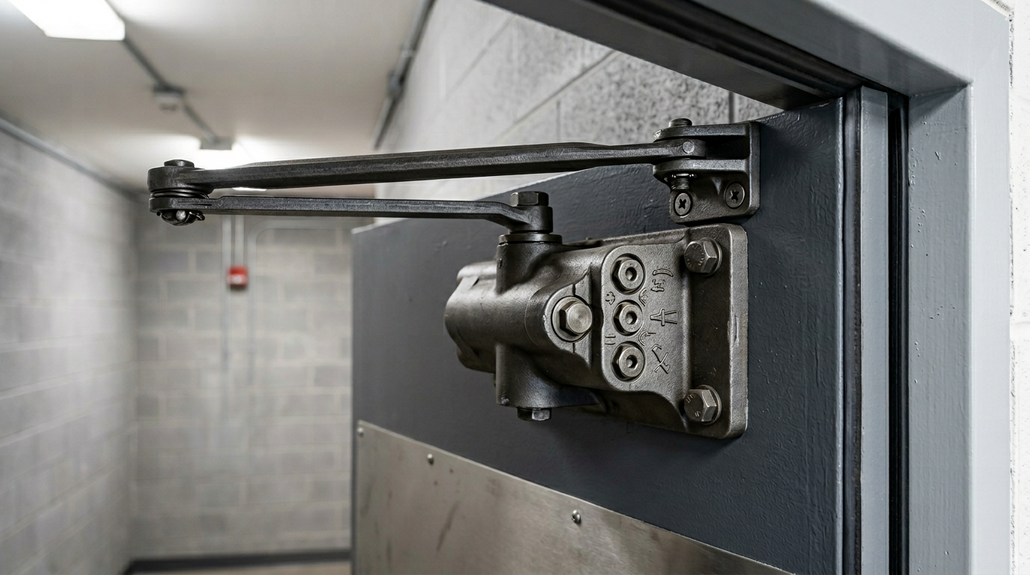
A commercial door closer is the hydraulic device mounted to a commercial door that closes the door after every opening at a controlled speed. Its correct behavior is governed by two field adjustments (sweep speed and latch speed), one structural setting (spring size), and optionally a third valve (backcheck) on heavy-duty models. When a closer slams, fails to latch, or leaves the door ajar, the fix is almost always an adjustment — not a replacement. This guide walks through the adjustment process, the sizing rules, the ADA opening-force math, and the failure modes where adjustment runs out and a new closer is the right answer.
For the complete framework on closer type selection, start with Door Closers Explained: Types, Grades and Installation Tips and How to Choose a Commercial Door Closer. For cold-weather-specific behavior, Door Closer in Cold Weather: Fix Slamming, Poor Latching covers seasonal adjustment.
Quick verdict
- Slamming door → turn the sweep speed valve clockwise (slower).
- Door not latching → turn the latch speed valve counter-clockwise (faster in the final few degrees).
- Door bounces open in wind → engage or tighten the backcheck valve.
- Door opens too hard → reduce spring size (turn the spring-size adjustment nut counter-clockwise on adjustable closers).
- Door opens too easy and does not close fully → increase spring size (clockwise).
- Adjustment valves bottom out with no change → the closer is at end-of-life. Replace it.
- Oil leaks from closer body → the closer is at end-of-life. Replace immediately.
Adjustment resolves 80% of closer complaints. Sizing resolves another 15%. The remaining 5% is worn-out bodies that need replacement.
The three adjustment valves
Every modern surface-mounted commercial door closer has two or three hex-head valve screws, usually on the end or front of the closer body. Each valve controls a different segment of the close cycle:
1. Sweep speed
Controls the main close cycle from fully open (90°) down to about 10° before the strike. This is the speed the door travels for the majority of its path. Most complaints of slamming, door-on-door impact, or noise come from sweep speed set too fast.
- Turn clockwise → slower sweep.
- Turn counter-clockwise → faster sweep.
- Adjust in small increments — a quarter turn at a time. Wait for the door to cycle five times between adjustments to let the hydraulic fluid settle.
2. Latch speed
Controls the final 10° before the door fully seats into the strike. This is a separate valve from sweep speed because the door needs extra energy in the last few degrees to overcome the latch spring and seat the bolt. If the latch speed is too slow, the door will stop short of the strike and stay cracked open. If it is too fast, the door will slam in the last segment.
- Turn counter-clockwise → faster latch (more energy to seat the bolt).
- Turn clockwise → slower latch.
- Adjust until the door latches cleanly without slamming. This is the valve most commonly mis-set by maintenance crews who do not know it exists.
3. Backcheck
Controls how far and how hard the door can be pushed past about 75°, which is where wind abuse and students (“swing attack”) typically apply force. Backcheck resists the door slamming open and damaging walls, hinges, or the closer arm. Not every closer has backcheck — it is standard on heavy-duty Grade 1 closers like the LCN 4040XP and Norton 7500 and optional on mid-tier closers.
- Turn clockwise → stronger backcheck.
- Turn counter-clockwise → lighter backcheck.
- Always engage backcheck on exterior doors in windy environments.
The adjustment sequence that actually works
The right order matters. Adjusting in the wrong sequence wastes time because each valve affects the next.
- Start with sweep speed. Set it so the door closes from 90° to 10° in roughly 5 to 7 seconds for an interior door, 4 to 6 seconds for an exterior door. Slower is ADA-safer; faster is security-friendlier.
- Then set latch speed. The last 10° should take about 1 to 2 seconds — enough to seat the latch cleanly without slamming.
- Finally set backcheck. Push the door hard at 80° and confirm it slows before hitting the stop. Tighten if it still hits the wall.
- Cycle the door 10 times and re-check. Hydraulic fluid takes a few cycles to redistribute.
- Document the settings on the door schedule. Closers that are repeatedly re-adjusted by different techs drift into bad states.
For the physical install that precedes adjustment, see How to Install a Door Closer: Complete Professional Installation Guide.
Spring size and ADA opening force
Adjusting the valves changes how fast the door closes. It does not change how hard the door is to push open. That is controlled by spring size.
ANSI-rated commercial closers are adjustable spring size 1 through 6 on most Grade 1 models. Each size maps to a door-width-and-weight range:
|
Spring size |
Door width (interior) |
Door width (exterior) |
|---|---|---|
|
1 |
up to 30” |
— |
|
2 |
up to 34” |
— |
|
3 |
up to 36” |
up to 32” |
|
4 |
up to 40” |
up to 36” |
|
5 |
— |
up to 42” |
|
6 |
— |
up to 48” |
ADA opening force on interior non-fire-rated doors is limited to 5 pounds-force at the door handle. Spring sizes 1 through 3 meet this on most standard door widths. Fire-rated doors are exempt from the 5 lbf limit because fire doors need enough spring to close against a gasket. This is why a fire-rated stair door can be hard to push open — it is code, not a broken closer.
To adjust the spring size on an adjustable closer, rotate the spring-size adjustment nut on the end of the closer body. Clockwise increases spring tension (harder to push, closes more firmly). Counter-clockwise decreases (easier to push, may fail to latch on a heavy door).
If your closer is not adjustable (some non-heavy-duty models are fixed-spring), the fix for an oversized or undersized door is a different closer, not an adjustment.
Common failure modes and what causes them
The door slams
- Sweep speed too fast → slow it down a quarter turn.
- Spring too strong for the door → reduce spring size or replace with a smaller closer.
- Backcheck disabled on a windy exterior → engage backcheck.
The door does not latch
- Latch speed too slow → speed it up a quarter turn.
- Spring too weak for the door or gasket → increase spring size.
- Door is out of square → the closer will not compensate; fix the hinges or door frame.
- Weather stripping is too aggressive → closer cannot overcome gasket drag; reduce the sweep strip or increase spring size.
- Closer body is out of oil (leak) → replace.
The door closes but then bounces back open
- Latch is not engaging the strike → check strike alignment and latch throw.
- Backcheck is engaged too firmly and rebounds → reduce backcheck slightly.
- Door is hitting a floor stop or carpet before the latch engages → fix the obstruction.
The door closes slowly in cold weather and fast in warm weather
- Normal hydraulic fluid behavior — fluid viscosity changes with temperature.
- Adjust sweep and latch speed seasonally. See Door Closer in Cold Weather for the seasonal swing playbook.
The door feels different every morning
- Someone has been adjusting the valves. Lock the cover or document the settings and train the maintenance team.
For multifamily-specific behavior where slamming doors become a tenant complaint, see Why Do Multifamily Homes Install Door Closers.
When adjustment runs out and it’s time to replace
The adjustment-vs-replacement decision is driven by four signs:
- Oil leaks from the closer body. The closer cannot rebuild its own seals. Replace.
- The adjustment valves turn freely with no effect on door behavior. The internal piston has worn past the hydraulic orifice. Replace.
- The arm shows bending or metal fatigue. Even if the body is fine, a bent arm is a latent failure. Replace the arm (and usually the body, because labor is the same).
- The closer is more than 20 years old on a heavy-use exterior door. Mechanical fatigue has accumulated; a new closer delivers cleaner behavior for the remaining service life of the door.
When you replace, browse the Surface Door Closers category for the most common replacements, or the Overhead Concealed Closers category if the opening uses an OHC. Do not replace like-for-like without reviewing the sizing. The door may have been mis-sized the first time. Use the sizing table above, and on heavy-duty exterior doors specify a Grade 1 closer like the LCN 4040XP or Norton 7500. For fire doors, specify a UL 10C listed model — see Best Door Closer for Commercial Building Fire Door.
Overhead concealed and non-surface closers
Surface-mounted closers cover 90% of commercial openings. The other 10% are overhead-concealed closers (OHC), floor closers, or knuckle closers, used on openings where the surface closer is aesthetically unacceptable (high-end lobbies, glass storefronts, historic renovations). Adjustment principles are similar — sweep, latch, and backcheck valves exist on all quality models — but the physical access to the valves is different. See Overhead Concealed Door Closers Specification Guide for the OHC-specific framework.
Maintenance schedule
Commercial door closers do not need scheduled lubrication. They do benefit from a scheduled inspection:
- Monthly: visual check for oil leaks, arm damage, and mounting-screw tightness.
- Quarterly: cycle the door ten times and listen for slamming, squeaking, or mid-cycle stutter.
- Twice yearly: seasonal adjustment of sweep and latch speed for temperature change.
- Annually: document the adjustment settings on the door schedule.
- Every 5 years (exterior, heavy use): replace proactively to avoid unexpected failure on life-safety doors.
For the full maintenance framework on commercial locks and closers, Commercial Door Lock Maintenance Checklist is the reference.
FAQ
Which valve is sweep and which is latch? On most closers they are labeled “S” and “L” next to the valve heads. If unlabeled, the valve closer to the arm is sweep; the valve farther from the arm is latch. Turn each one a quarter turn and observe the effect on the door.
Can I over-tighten the valves and break the closer? Yes. Stop at the point where the valve becomes firm. Over-tightening strips the seat and causes a permanent hydraulic leak.
How hot should the closer body feel in operation? Slightly warm at most. A hot closer body means the hydraulic fluid is breaking down and the closer is near end-of-life.
Do I need tools to adjust? A hex (Allen) wrench is required for the valve adjustments. Some newer closers use captive screwdriver adjustments. No power tools needed.
How long does it take to adjust one closer? Five minutes once you know where the valves are. Ten to fifteen minutes if you are also diagnosing the cause.
When should I call a locksmith instead of adjusting myself? When oil is leaking, the arm is bent, or the closer is mounted on a fire-rated opening that you are not certified to service. Fire-rated closers must be adjusted by a qualified technician who can document the work for the building’s fire-label compliance.