 SAME DAY & EXPEDITED SHIPPING AVAILABLE






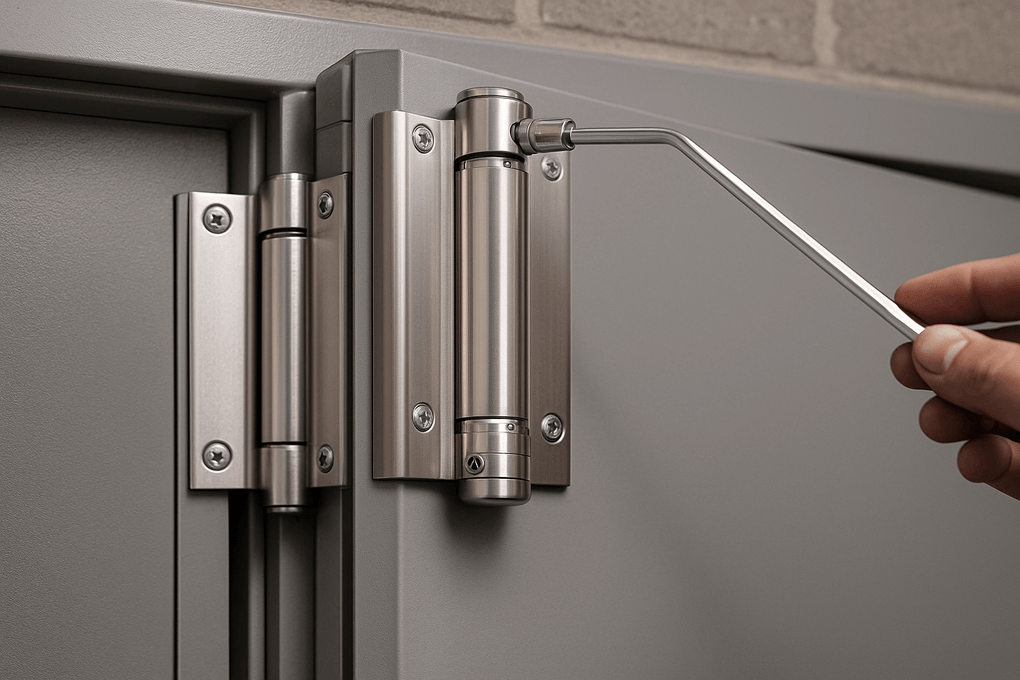
How to Adjust Spring Loaded Hinges: Steps and Limits
Posted by National Lock Supply on Dec 1st 2025
To adjust a spring loaded hinge, close the door, insert a hex wrench into the hinge's adjustment hole, turn it to wind the spring, and drop the tension pin into the next hole while holding the wrench. Release the wrench until the pin seats, then test the door. Add one hole at a time. Use the minimum tension that closes and latches the door.
How Do You Adjust Spring Hinges?
Hager and McKinney spring hinges both use the same principle: a pin sets the spring in one of several holes, and each hole adds closing force. Steps for a typical full mortise spring hinge:
- Install the hinge normally and put the door in the closed position.
- Insert the hex wrench into the hex hole in the barrel.
- Turn the wrench to increase tension until the pin hole lines up with the next hole, and insert the tension (cross or locking) pin loosely.
- Slowly release the wrench until the pin contacts the side of the hole.
- Remove the wrench and check the closing force. If it is not enough, repeat on every hinge.
Turning direction depends on the hinge and on whether the adjustment end faces up or down. Hager says clockwise when viewed from the adjustment end. McKinney says to turn the wrench left (clockwise) when the adjustment end is up, and right (counterclockwise) when it is down. Confirm direction on your hinge's instruction sheet.
How Much Tension Is Too Much?
Manufacturers limit the number of tension holes, and exceeding it shortens spring life and can damage the hinge.
| Manufacturer | 180 degree opening | 90 degree opening |
|---|---|---|
| Hager 1150, 1250, 1750 | Not past 3 holes | Not past 4 holes |
| McKinney (MPS60 sheet) | Not past 3 holes | Not past 5 holes (7 holes for 4.5 in. hinges) |
McKinney's instruction sheet also states to adjust to the minimum tension required to close the door, since over-tensioning reduces spring life. Limits vary by series, so check the sheet that came with your hinge.
How Do You Tighten Spring Hinges When the Door Won't Close or Latch?
First rule out alignment. Hager's instructions say to open the door to 90 degrees and push it closed: if it does not latch, the door is out of balance or misaligned, and that has to be corrected before tension is applied. Check sagging, bound hinge leaves and frame rack, then add tension one hole at a time on all spring hinges equally. If you reach the limit and the door still will not latch, the hinges are undersized for the door weight. Use the manufacturer's weight table, which lists how many spring hinges a given door weight needs, or add a spring hinge or a door closer.
How Do You Reduce Tension When the Door Slams?
Close the door, put the wrench in the hole, hold it firmly, pull the tension pin, ease the wrench back one hole and re-insert the pin. Test and repeat on each hinge. Never let go of the wrench while the pin is out.
How to Adjust Fire Door Spring Hinges
NFPA 80 requires swinging fire doors to be self-closing, and the closing device must be adjusted so the door positively latches on every operation. Spring hinges are one accepted way to do that. McKinney's sheet for its spring hinges for rated doors notes that NFPA 80 calls for a minimum of two spring hinges on labeled doors, and that three may be required depending on hinge size, door type and door weight. When adjusting:
- Do not remove or swap hinges on a labeled door for non-listed hardware.
- Test that the door closes and latches from a partly open position after every adjustment.
- Record the result in the opening's inspection record. Check with the authority having jurisdiction or your fire door inspector for local requirements.
Common Adjustment Mistakes
- Adding tension to cure an alignment or binding problem
- Adjusting only one hinge so the door twists on its hinges
- Exceeding the hole limit for the door's swing angle
- Letting go of the hex wrench before the pin is seated
- Forgetting to drive or snip the cross pin when the sheet calls for it. McKinney says snipping off the break-away head makes the setting tamperproof, but only do that if future adjustment will not be needed.
Opening Force and Accessibility
Closing force has to be balanced against the opening force the code allows on accessible routes. Under the 2010 ADA Standards, interior hinged doors are limited to 5 pounds of opening force, and fire doors are exempt from that limit and use the minimum force their authority requires. Keep tension at the lowest setting that latches the door.
FAQ
How do you adjust a spring hinge on a door?
Close the door, wind the spring with the hex wrench, set the tension pin in the next hole, release the wrench and test. Repeat one hole at a time.
What size hex key do spring hinges use?
It varies by manufacturer and hinge series. Check the hinge's instruction sheet, because a wrong size strips the socket.
How many holes of tension should I use?
As few as will close and latch the door, and never past the limit for your swing angle. See the table above.
Do spring hinges replace door closers?
On many lighter doors yes, but heavy or high-traffic doors may need a door closer instead. Follow the manufacturer's door weight table.
How do I take a spring hinge off to replace it?
Release the tension first, then follow our steps in how to remove spring loaded hinges.
Official sources: Hager spring hinge instructions, McKinney spring hinges for rated doors.
Next Step
Browse spring hinges such as the McKinney 1502 and Stanley 2060R, or the full door hinge range. Orders placed before 3:00 p.m. ET ship the same business day, with free ground shipping on $450 and up. Request a quote or call 718-814-6300.