 SAME DAY & EXPEDITED SHIPPING AVAILABLE






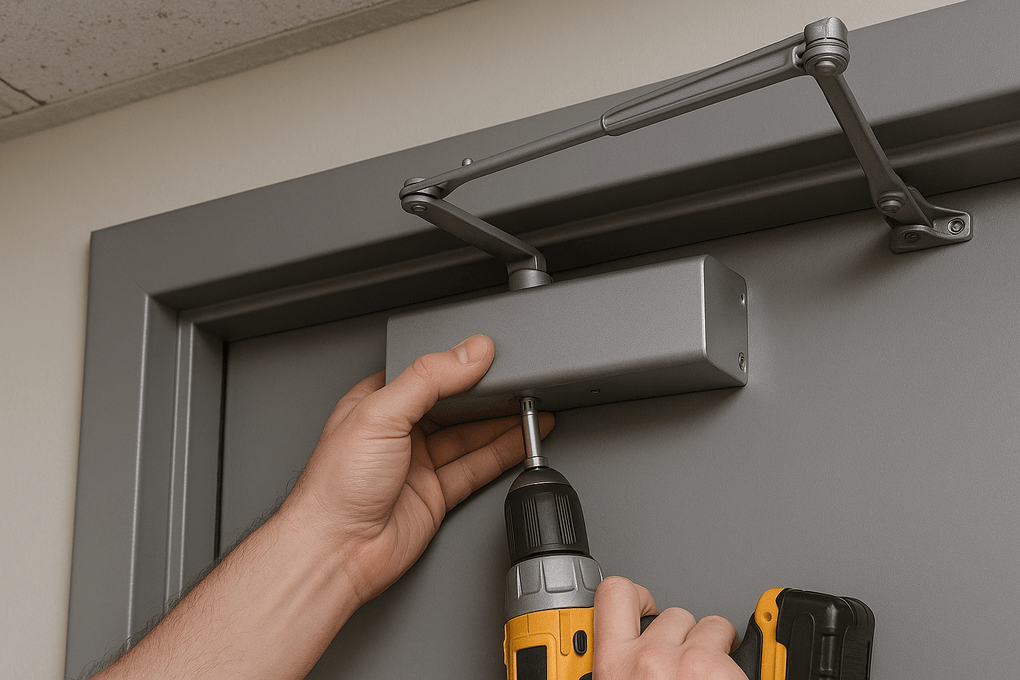
How to Install a Door Closer: Complete Professional Installation Guide
Posted by National Lock Supply on Dec 2nd 2025
Door closer installation transforms any commercial opening into a code-compliant, self-closing system with adjustable speed control that spring hinges cannot match. Facility managers specify door closers for fire-rated corridor doors, high-traffic retail entrances, accessible openings requiring precise ADA force compliance, exterior doors subjected to wind pressure, and security applications where controlled closing speed prevents door damage while ensuring positive latching. Unlike spring hinges that offer limited adjustment, hydraulic door closers provide independent control over sweep speed, latch speed, and backcheck, critical features for meeting both accessibility requirements and fire safety standards in a single installation.
Professional door closer installation requires more than mounting the hardware and walking away. You need to select the appropriate closer size for door width and weight, determine optimal mounting configuration based on door swing and frame construction, verify frame reinforcement adequacy for closer loads, and perform systematic valve adjustment to achieve closing performance that satisfies both operational requirements and code compliance.
Door Closer Types and Mounting Configurations
Surface-Mounted Door Closers
Surface-mounted door closers are the most common configuration in commercial installations, with the closer body visible on either the door or frame and an articulating arm connecting to the opposite surface. These closers offer straightforward installation, easy adjustment access, and proven reliability across millions of commercial openings. The closer body contains the hydraulic mechanism, spring, and adjustment valves, all accessible for maintenance without disturbing the mounting.
Three primary arm configurations accommodate different aesthetic and functional requirements. Regular arm (standard arm) mounts the closer body on the pull side of the door with the arm extending to the frame, providing maximum closing power and control. This configuration works well for interior doors but creates a visible hardware presence that some applications want to minimize. Parallel arm (top jamb) mounts the closer on the push side with the arm running parallel to the door top, reducing hardware visibility when the door is closed, ideal for exterior doors or locations where minimizing hardware exposure matters.
Top jamb mounting places the closer body on the frame head with the arm connecting to the door, completely hiding the closer when the door is closed. This configuration suits storefronts, aluminum entrances, and architectural applications where a clean appearance is essential. Installation complexity increases with top jamb mounting, frame reinforcement requirements are more demanding since the closer mounts to the frame rather than the door, and adjustment access may be limited by frame depth or clearance restrictions.
Concealed Door Closers
Concealed door closers are installed completely hidden within the door, frame, or floor, leaving minimal or no visible hardware. Overhead concealed closers fit in the frame head with only a small arm visible on the door face, popular in commercial office buildings and retail spaces, emphasizing clean contemporary aesthetics. Floor closers embed in the floor beneath the door pivot, providing completely invisible operation for all-glass entrances and architectural applications where hardware visibility is unacceptable.
Installation complexity and cost increase substantially with concealed closers. Overhead concealed models require adequate frame head depth (typically 4-5 inches) and may need custom frame modifications during building construction. Floor closers demand concrete floor pockets during initial construction; retrofitting floor closers into existing buildings rarely proves practical due to floor cutting requirements and pivot alignment challenges.
Maintenance considerations favor surface-mounted over concealed configurations. Accessing concealed closer adjustment valves requires removing ceiling tiles, accessing floor pockets, or dismounting door panels, labor-intensive procedures that increase service costs. Surface-mounted closers adjust with a screwdriver in minutes, while concealed models may require an hour or more for equivalent adjustments.
Shop commercial door closers with adjustable speed control and ADA-compliant force settings for reliable performance across diverse applications.
Pre-Installation Planning and Assessment
Door and Frame Compatibility Verification
Begin by measuring door dimensions and calculating the approximate weight. Standard commercial door closers handle doors from 2'6" to 4'0" width, weighing up to 200 pounds, with size designations (typically 1-6) indicating power capacity. A 3'0" x 7'0" solid core door weighing approximately 150 pounds requires a size 3 or 4 closer, while a 4'0" x 8'0" exterior steel door needs size 5 or 6. The Sargent 351 series provides universal sizing suitable for most commercial interior applications, while heavy-duty institutional models like the LCN 4040XP handle oversized or extreme-duty installations.
Frame construction determines mounting feasibility and reinforcement requirements. Hollow metal frames typically include reinforcement plates at closer mounting locations, verify these exist and align with the closer template before purchasing hardware. Wood frames require blocking or reinforcement added during installation to prevent fastener pullout under repeated closing cycles. Aluminum storefront frames need special consideration, many aluminum sections lack adequate wall thickness for standard closer mounting, requiring surface-mounted brackets or specialized fasteners.
Fire rating requirements affect closer selection significantly. Fire-rated doors must use UL-listed closers with ratings matching or exceeding the door assembly rating. Check the door label for rating duration; 90-minute doors need closers rated minimum 90 minutes, 3-hour doors require 3-hour rated closers. Using non-rated closers on fire doors voids the assembly certification and creates code violations during fire marshal inspections.
Environmental and Operational Considerations
Exterior doors require closers rated for temperature extremes and weather exposure. Standard hydraulic closers operate reliably in -15°F to 150°F ranges, adequate for most interior applications. Exterior installations in severe climates need special low-temperature fluid or dual-piston designs maintaining performance to -40°F. The closer body should include weather covers protecting adjustment valves from moisture infiltration that causes corrosion and valve seizure.
Wind exposure dramatically affects closer sizing. Doors in high-rise buildings, exposed building corners, or locations with significant HVAC pressure differentials need oversized closers or models with backcheck valves that prevent door slam when wind-assisted opening occurs. Calculate wind loads per local building codes; areas with hurricane or severe wind requirements may mandate specific closer specifications exceeding standard commercial grades.
Required Tools and Materials
Installation Equipment
Door closer installation requires standard carpentry and hardware tools: power drill with bits matching closer fastener sizes, screwdriver or driver bits for valve adjustment (typically 1/8" or 5/32" hex), tape measure and level for layout verification, pencil for marking mounting locations, and a door template or closer installation template provided by the manufacturer. Professional installations benefit from a center punch for marking screw locations accurately and preventing drill bit wandering on metal surfaces.
The closer template is essential; never attempt installation without it. Templates show exact mounting hole locations, accounting for variations between closer models and mounting configurations. Templates typically come as adhesive-backed paper that sticks temporarily to the door or frame, providing precise hole location reference. Drilling even slightly off-template creates misalignment that prevents proper arm articulation or causes binding throughout the closing cycle.
Fasteners and Reinforcement Hardware
Closer manufacturers specify fastener types and sizes matched to expected loads. Most surface-mounted closers use #12 or #14 wood screws for wood doors, or machine screws that thread into tapped holes or speed clips for hollow metal doors. Never substitute fasteners; using shorter screws reduces holding strength, while incorrect thread pitch prevents proper tightening in tapped holes.
Frame reinforcement may require additional materials not included with the closer. Wood frame installations need backing plates or substantial blocking behind the frame to distribute closer loads adequately. Hollow metal frames without factory-installed reinforcement plates require through-bolt installation with reinforcement plates behind the frame. Contact the frame manufacturer for appropriate reinforcement hardware before attempting closer installation.
Step-by-Step Installation Process
Professional door closer installation follows a systematic sequence, ensuring proper alignment, secure mounting, and optimal performance. Rushing through setup or skipping verification steps creates problems requiring complete reinstallation to correct. Work methodically through each phase, testing fit and alignment before proceeding to irreversible modifications.
Template Positioning and Layout
Remove the door closer from the packaging and identify all components: closer body, arm assembly, mounting bracket (if required for your configuration), installation template, fasteners, and adjustment tools. Read the manufacturer's instructions completely before starting; different closer models have specific requirements that generic procedures don't address.
Position the installation template on the door or frame according to the mounting configuration you've selected. For regular arm installation, the template mounts on the pull side of the door (the side the closer body will mount). Align the template edge with the hinge edge of the door, positioning it according to template markings, typically 4-6 inches from the top of the door, depending on door height and closer model. Secure the template with masking tape, verifying its level and proper positioned before marking hole locations.
Use a center punch to mark each mounting hole location through the template. These punch marks prevent the drill bit from wandering when starting holes, ensuring accurate hole placement. For hollow metal doors, verify you're drilling into areas with frame reinforcement; mounting outside reinforced zones results in fastener pullout. Some templates include translucent areas allowing you to see through and verify reinforcement location before drilling.
Drilling Mounting Holes
Remove the template and drill pilot holes at each marked location. For wood doors, use a bit sized 75% of the screw diameter, typically 7/64" or 1/8" for #12 screws. Drill perpendicular to the surface to ensure fasteners seat properly and provide maximum holding strength. Depth should slightly exceed screw length to prevent bottoming before the screw head seats.
Hollow metal doors require a different technique depending on whether tapped holes or self-tapping screws are specified. For tapped holes, drill the tap drill size specified in the instructions (typically 13/64" for #12-24 threads), then tap threads using the appropriate tap. Apply cutting oil and turn the tap slowly, backing out periodically to clear chips. Self-tapping screws eliminate threading but require precise drill bit sizing, too large and the threads don't engage, too small and the screws strip during installation.
Frame drilling follows similar procedures but demands extra attention to perpendicularity. The closer arm must align precisely between door and frame mounting points; holes drilled at angles cause arm binding that prevents smooth operation. Use a drill guide or take extra care to maintain perpendicular drilling, particularly on hollow metal frames, where angled holes may penetrate through the back of the frame.
Mounting the Closer Body
Position the door closer body at the mounting location, aligning holes with drilled pilot holes. Install fasteners hand-tight initially, threading all screws before fully tightening any. This allows minor position adjustment if holes don't align perfectly. Once all fasteners start, tighten them progressively in a star pattern to distribute clamping force evenly and prevent closer body distortion.
Torque specifications matter; overtightening wood screws crushes wood fibers, reducing holding strength, while undertightening creates loose mounting that allows closer movement under load. Machine screws in metal doors require 15-20 inch-pounds typically. Use a torque driver if available, or tighten firmly by hand without excessive force. The closer body should sit flat against the mounting surface with no gaps or rocking.
For parallel arm configurations requiring a mounting bracket, install the bracket to the door or frame following the same procedure as the closer body. Bracket alignment is critical; misalignment prevents proper arm geometry and causes binding or reduced closing power.
Arm Installation and Adjustment
Attach the arm assembly to the closer body according to the manufacturer's instructions. Most closers use a forearm that connects to the closer shaft with a set screw or clip, and a connecting arm that links the forearm to the frame bracket or shoe. Arm length and angle adjustment accommodate various door and frame configurations. Follow the template guidance for initial setup.
With the arm connected at both ends, open the door to approximately 90 degrees and verify smooth operation throughout the swing arc. The arm should articulate freely without binding at any point. Binding indicates mounting misalignment, incorrect arm length adjustment, or interference with door or frame components. Correct any binding before proceeding; forcing a binding closer causes premature wear and may damage the arm or mounting points.
Some closers include backcheck adjustment, limiting door opening speed, and preventing wall damage when doors open too quickly. Set the backcheck initially to the mid-range position, testing door opening to ensure it slows smoothly near full open without completely preventing opening. Fine-tune backcheck during the final adjustment phase based on actual door operation.
Upgrade to institutional-grade closers with heavy-duty construction for healthcare, education, and government facilities requiring extended service life.
Closer Adjustment and Speed Control
Understanding Adjustment Valves
Door closers include multiple adjustment valves controlling different phases of the closing cycle. Sweep speed (main speed) controls how fast the door closes through the main arc from full open to approximately 10-15 degrees from closed. Latch speed (terminal speed) controls the final closing phase, ensuring the door has sufficient speed to overcome latch resistance and close positively without slamming. Backcheck (if present) limits opening speed, preventing door or wall damage when doors open quickly.
Valves typically use small adjustment screws accessed from the closer body side or end. Turning valves clockwise decreases speed (increases hydraulic resistance), while counterclockwise rotation increases speed (decreases resistance). Most manufacturers limit adjustment to 2 full turns maximum in either direction; excessive adjustment strips internal valve threads or causes fluid bypass that prevents proper speed control.
Systematic Adjustment Procedure
Start with all adjustment valves in the mid-range position (typically 1 turn out from fully closed). Open the door fully and release it, observing closing behavior through the complete cycle. The door should close steadily through the main arc, then accelerate slightly in the final 10-15 degrees to overcome latch resistance and close positively.
Adjust sweep speed first. If the door closes too slowly through the main arc, turn the sweep valve 1/4 turn counterclockwise and test again. If too fast, turn clockwise 1/4 turn. Make small incremental adjustments, testing after each change. Aggressive adjustment overshoots the target, requiring multiple correction attempts. Target sweep time is typically 5-7 seconds from 90 degrees open to 15 degrees from closed, though specific requirements vary by application and code.
Once sweep speed is correct, adjust latch speed. The door should accelerate in the final closing phase, providing enough speed to engage the latch without slamming the door into the frame. Latch speed that's too slow causes the door to stop before latching, while excessive speed creates door slam and noise complaints. Adjust in 1/4 turn increments until the door closes and latches smoothly with minimal impact noise.
ADA Compliance Verification
The Americans with Disabilities Act requires accessible doors to open with a maximum of 5 pounds of force for interior doors, 8.5 pounds for exterior doors. After completing speed adjustments, test the opening force with a calibrated force gauge at the latch edge. If the opening force exceeds ADA limits, reduce closer size, adjust spring tension (if adjustable), or verify that the door and hardware aren't creating excessive resistance through binding or misalignment.
Some closers include adjustable spring tension, allowing force tuning without changing the closer size. Reduce spring tension in small increments, testing both opening force and closing performance after each adjustment. The challenge involves balancing adequate closing force for positive latching against ADA opening force limits; the adjustment window is narrow, particularly on exterior doors with weatherstripping resistance.
Document final adjustment settings and opening force measurements. For commercial installations, this documentation supports accessibility compliance audits and provides baseline data for future maintenance adjustments as the closer ages and performance drifts.
Troubleshooting Installation Issues
Door Fails to Latch
When the door closer brings the door nearly closed but doesn't engage the latch, increase latch speed gradually until positive latching occurs. If maximum latch speed still doesn't latch the door, check for: latch bolt binding requiring lubrication or adjustment, strike plate misalignment preventing latch engagement, weatherstripping or threshold creating excessive resistance, or closer undersized for the application resistance.
Verify the latch bolt projects a minimum of 1/2" from the door edge; a short latch projection may not reach the strike plate even when the door appears fully closed. Adjust or replace latch hardware as needed. Check strike plate position; the latch bolt must align precisely with the strike opening. Minor misalignment adjustments using shims behind the strike plate often resolve latching issues without closer modification.
Door Slams or Closes Too Rapidly
Excessive closing speed indicates the latch speed valve opened too far, or the sweep speed is too fast through the main closing arc. Reduce both valves progressively in 1/4 turn increments until closing speed reaches acceptable levels. If both valves are at minimum opening (fully closed) and the door still slams, the closer is oversized for the application; install a smaller closer with less closing power.
Environmental factors, including negative building pressure or wind, can override closer adjustment, causing excessive closing speed. Doors in buildings with significant HVAC pressure differentials or high-rise locations with stack effect may require door closer selection specifically accounting for these forces. Consider adding a backcheck adjustment or upgrading to a closer model with enhanced wind resistance features.
Closer Leaks or Makes Noise
Hydraulic fluid leaking from the closer body or arm connections indicates seal failure requiring closer replacement. Modern closers use sealed hydraulic systems not designed for field service; leaking units need replacement rather than repair attempts. Small amounts of fluid weeping from adjustment valve stems during initial cycles are normal as air purges from the system, but significant leaks represent failure.
Grinding or squeaking noises during closing typically indicate arm binding, insufficient lubrication at pivot points, or internal closer damage. Verify arm alignment and articulation; binding creates noise and accelerates wear. Apply light oil to external pivot points if permitted by the manufacturer. Internal noises suggesting mechanical failure require closer replacement.
Browse complete door hardware solutions, including panic bars and exit devices for life safety applications requiring coordinated door control.
Maintenance and Long-Term Performance
Periodic Inspection and Adjustment
Door closers require semi-annual inspection to maintain optimal performance and catch developing issues before they cause failure. Check closing speed through multiple cycles; speed variations suggest valve adjustment drift or internal wear. Verify the door latches positively from all opening positions. Inspect arm connections for looseness or wear, and check mounting fasteners for tightness.
Speed adjustment naturally drifts over time as seals wear and hydraulic fluid properties change with age. Plan for minor adjustment during annual maintenance cycles, typically requiring a slight increase in closing speed to compensate for internal wear. Document adjustments in maintenance logs, increasing adjustment frequency signals approaching the end of service life.
Clean closer bodies semi-annually using mild soap and water, avoiding harsh solvents that damage finishes or seals. Inspect for fluid leaks around the body, arm shaft, or adjustment valves. Address leaks promptly through closer replacement, leaking units lose closing force as fluid escapes, and leaked fluid creates slip hazards and attracts dirt.
Replacement Indicators
Replace door closers when adjustment no longer maintains acceptable closing performance, visible fluid leaks appear, mounting fasteners pull loose repeatedly despite proper installation, or internal noises indicate mechanical failure. Commercial closer service life typically ranges from 7 to 12 years, depending on traffic volume and environmental conditions. Plan replacement before complete failure occurs.
Consider upgrading closer specifications during replacement if the original closer struggled to meet performance requirements. Doors that require constant adjustment or operate at adjustment limits throughout service life benefit from larger or more capable closer models. Similarly, doors now subjected to higher traffic or changed environmental conditions may need heavier-duty closers than the original.