 SAME DAY & EXPEDITED SHIPPING AVAILABLE






Holiday Shutdown Security: Core Swap, Rekey, or Keyless?
Posted by National Lock Supply on Dec 19th 2025
Extended holiday closures create security vulnerabilities that year-round operations never experience. Buildings sit empty for days or weeks with no staff observing unauthorized access attempts, terminated employees retain keys providing access during periods with no witnesses, and contractors who completed work weeks earlier still possess keys with no immediate need compelling their return. These accumulated access risks transform the holiday period into a prime window for theft, vandalism, or industrial espionage.
Three primary strategies address holiday shutdown security: conventional rekeying replacing all lock pins requiring 15-20 minutes per cylinder, interchangeable core swaps exchanging complete cores in 10-15 seconds per lock, or migration to electronic access control eliminating physical keys entirely. Browse mechanical locks and electronic access control for comprehensive security solutions.
Conventional Rekeying Cost and Timeline Analysis
Labor Requirements Per Cylinder
Conventional cylinder rekeying requires complete disassembly, pin replacement matching new key cuts, and reassembly with operational verification. A competent locksmith completes this process in 15-20 minutes per cylinder including setup time. Facilities with 100 keyed openings require 25-35 labor hours minimum for complete rekeying. At typical commercial locksmith rates of $85-125 per hour, labor costs alone run $2,100-4,400 before considering materials, mobilization, or after-hours premiums.
The timeline constraint proves equally significant. A single locksmith rekeying 8-10 cylinders per hour needs 10-12 hours completing a 100-opening facility--more than one full workday. Most facilities cannot grant locksmith access during normal business hours for security reasons. After-hours or weekend work typically carries 50-75 percent premium rates, raising the total cost substantially. Two-locksmith teams cut the timeline but double labor costs.
Material costs add to labor expenses. Each cylinder requires new pins matching the new key cuts--typically $2-5 in pins per cylinder depending on security level and manufacturer. New keys cost $3-8 each depending on complexity and security features. A 100-opening facility might distribute 250-300 keys across employees and management, adding $750-2,400 in key cutting costs. Total rekeying costs thus range $3,000-7,000 for moderately sized facilities.
Disruption and Access Planning
Rekeying creates operational disruption requiring coordination across departments. All existing keys become invalid simultaneously, requiring comprehensive key distribution before reopening the facility. Missing even one key holder who left for vacation before receiving new keys creates access problems requiring locksmith callout on reopening day--expensive emergency service at 2-3 times normal rates.
The new key distribution process involves tracking every key issued, documenting which employees received which keys, and establishing accountability for key control going forward. This administrative burden consumes management time during the already hectic holiday season. Poor execution leaves staff locked out, creates security gaps from unreturned old keys, or results in duplicate issuance when tracking breaks down.
Interchangeable Core Systems Advantages
Rapid Core Exchange Methodology
Facilities using interchangeable core systems rekey by exchanging complete lock cores rather than disassembling individual cylinders. A maintenance staff member inserts the control key, rotates, and extracts the old core, then inserts a new core cut to different keying. The entire process takes 10-15 seconds per lock. A 100-opening facility requires approximately 15-20 minutes total for complete rekeying by one person.
This dramatic time reduction allows completion during normal maintenance operations without expensive locksmith mobilization. The facility can rekey immediately before holiday closure begins and immediately after reopening if desired, eliminating the extended vulnerability window where terminated employees retain functional keys. Browse interchangeable cores in SFIC and LFIC formats for rapid security reset capability.
Cost comparison favors IC systems dramatically for facilities planning multiple rekeying events. Initial IC system installation costs 40-60 percent more than conventional cylinders--a facility spending $15,000 on conventional locks might spend $22,000-24,000 for equivalent IC hardware. However, each subsequent rekey costs only the replacement cores at $35-100 each depending on format and security level. Core inventory for a 100-opening facility runs $3,500-10,000 versus $3,000-7,000 per conventional rekey event. After the first post-installation rekey, IC systems provide cost savings that increase with each subsequent security reset.
Strategic Core Inventory Management
Successful IC deployment requires maintaining adequate core inventory to support immediate security resets. Facilities should stock one complete set of spare cores at minimum--100 cores for a 100-opening facility. Conservative facilities maintain two complete sets, allowing security reset while the removed cores are being re-pinned for the next cycle. This inventory investment runs $3,500-20,000 depending on facility size and core format.
The removed cores do not become waste--they return to the locksmith for re-pinning to new keying, creating a renewable core pool. Re-pinning costs $15-25 per core, significantly less than purchasing new cores. Facilities establish a rotation where cores removed during rekeying get re-pinned and held as spare inventory for the next security reset. This sustainable model spreads costs over time rather than requiring large expenditures for each rekey event.
Control key security proves critical in IC systems since control keys provide rekeying access to any lock in the system. Facilities limit control key distribution to security directors and senior maintenance staff with signed accountability. Some facilities use segmented control key systems where different control keys operate different building sections, limiting damage from control key compromise to specific facility areas.
Electronic Access Control Migration Strategy
Elimination of Physical Key Vulnerabilities
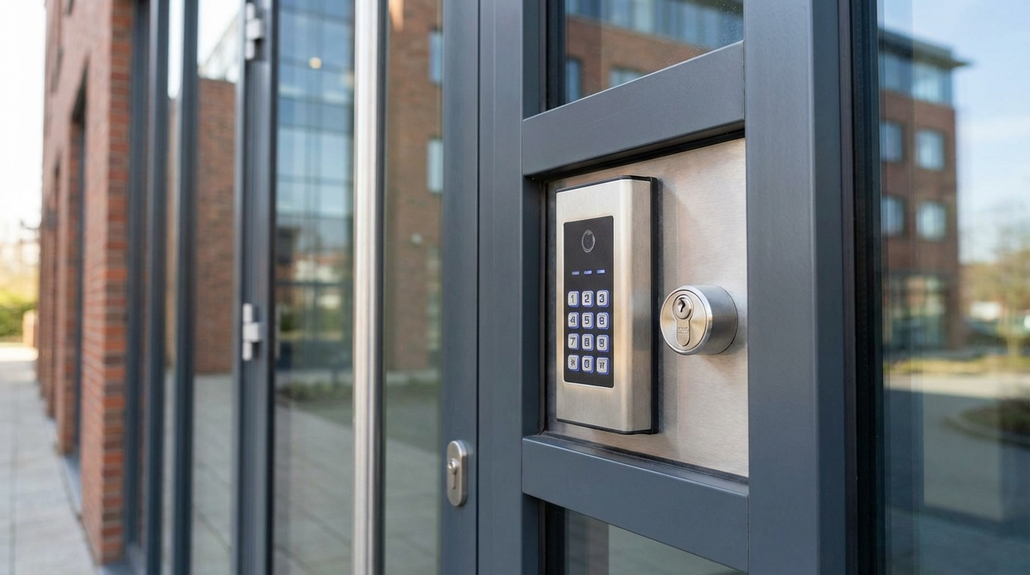
Electronic access control systems replace physical keys with credentials--cards, fobs, PIN codes, or biometrics--that software can instantly activate or deactivate. Terminating an employee requires only deactivating their credential in the access control database; the former employee loses building access immediately without needing to physically collect keys. This instant security reset eliminates the holiday vulnerability from unreturned keys.
The systems provide comprehensive access logging documenting every entry--who accessed which door, when, and whether access was granted or denied. This audit trail proves invaluable during security incidents, identifying the specific individuals who entered areas where theft or vandalism occurred. Physical key systems provide no such accountability; stolen items offer no evidence indicating which key holder was responsible.
Credential distribution and replacement proves simpler than key management. Lost or damaged credentials cost $2-5 each versus $3-8 for physical keys, and facilities can program replacement credentials immediately from existing inventory rather than waiting for key cutting. Employees can carry a single credential providing access to all authorized areas rather than carrying multiple keys for different door groups.
Implementation Costs and ROI Timeline
Electronic access control requires significant upfront investment. A basic system for 20 doors runs $12,000-20,000 including electric strikes, card readers, credentials, access control panel, power supplies, and installation labor. Larger facilities with 100 doors might invest $50,000-100,000 for complete systems. These costs substantially exceed conventional lock hardware or even IC systems.
However, operational cost savings accumulate over time. Facilities eliminate rekeying costs entirely--no locksmith labor, no core inventory, no key cutting. Credential deactivation is instant and free. Lost credential replacement costs $2-5 versus $15-25 for rekeying a lock when keys are lost. Administrative burden drops as the system handles access control automatically rather than requiring manual key tracking and distribution.
ROI timelines vary by facility size and rekeying frequency. A facility spending $5,000 annually on rekeying events achieves payback on a $25,000 access control system in 5 years before considering operational savings from reduced lost key incidents and improved security. High-security facilities rekeying quarterly or more frequently achieve payback in 2-3 years. Low-security facilities rekeying only for employee terminations may not achieve payback for 10+ years, making electronic access control a security investment rather than cost savings measure.
Holiday-Specific Security Protocols
Pre-Shutdown Security Audit
Conduct comprehensive security audits 2-3 weeks before holiday shutdown begins. Document all outstanding keys including employee keys, contractor keys, vendor keys, and temporary keys issued for maintenance or delivery access. Contact all key holders requesting immediate return of keys no longer needed. This advance notice provides time for follow-up with non-responsive key holders before the shutdown window opens.
Review access control logs if electronic systems are in place, identifying credentials that have not been used in 30+ days indicating terminated employees who have not returned credentials or current employees whose credentials can be deactivated during shutdown. Test all locks and access points verifying proper operation--doors that fail to latch properly, locks with excessive wear, or electronic strikes not releasing reliably require correction before the facility sits unattended for extended periods.
Inspect physical security beyond the locking systems. Check door frames for damage allowing bypass even with functional locks. Verify window security in accessible locations. Test alarm systems if installed. Confirm adequate exterior lighting at all entry points deterring casual attempts at unauthorized access. For complete pre-shutdown security preparation, evaluate door closers ensuring doors latch properly and panic hardware remains functional for emergency egress.
Post-Shutdown Security Reset Options
The most conservative approach rekeys immediately before shutdown and again immediately after reopening. This dual reset ensures no keys outstanding during the unattended period remain functional afterward. The paranoid approach costs double--two complete rekey cycles--but provides absolute certainty that any unauthorized key duplication during the shutdown window becomes worthless when the post-holiday rekey completes.
A balanced approach rekeys only after reopening, accepting the risk that keys unreturned before shutdown could be used during the unattended period but eliminating that vulnerability going forward. This strategy makes sense for facilities with good key accountability showing all contractors and terminated employees returned keys before shutdown. The single rekey provides post-holiday security reset at half the dual-rekey cost.
Facilities with electronic access should deactivate all credentials before shutdown except security personnel and essential maintenance staff requiring building access during the closure period. Reactivate employee credentials on the reopening date, requiring any staff needing holiday access to request temporary activation through security. This approach minimizes active credentials during the vulnerability window while maintaining operational flexibility.
Decision Matrix for Security Strategy Selection
Select conventional rekeying for facilities with fewer than 25 openings, infrequent rekeying needs--once every 2-3 years or less--and limited budget for security infrastructure investment. The one-time costs remain manageable at this scale, and the operational simplicity avoids complexity from IC or electronic systems. Small businesses, professional offices, and low-security retail operations typically fit this profile.
Choose IC systems for facilities with 25-100 openings expecting frequent security resets--quarterly or more often--due to employee turnover, contractor management, or regular security audits. The upfront investment pays back quickly through reduced rekeying costs, and the rapid reset capability provides security flexibility. Schools, small manufacturing facilities, multi-tenant office buildings, and businesses with high employee turnover benefit significantly from IC systems.
Implement electronic access control for facilities exceeding 100 openings, high-security environments requiring detailed access logging and accountability, or operations with complex access requirements including time-zone restrictions, visitor management, or integration with other security systems. Universities, hospitals, corporate headquarters, government facilities, and high-security industrial sites justify electronic access investments through both security enhancement and operational efficiency.
Employee Communication and Training
Communicate security changes clearly to all affected personnel minimum two weeks before implementation. Explain what is changing--new keys, new credentials, new procedures--and why the changes support facility security. Provide specific instructions for key or credential return, pickup of new keys or credentials, and whom to contact with questions or problems.
Train staff on new key control policies if implementing IC systems or tightening existing key accountability. Emphasize that keys must never be loaned to other employees, duplicated at outside key shops, or removed from the facility. Explain consequences for key policy violations including termination for serious breaches. Document training attendance creating accountability records.
For electronic access implementations, conduct hands-on training showing employees how to use new card readers, enter PIN codes, or present biometric credentials. Demonstrate what to do when credentials do not work--who to call, alternative entry procedures, emergency override methods. This training prevents the first-day chaos common when electronic systems deploy without adequate user preparation. For complete security system planning and implementation, review access control components and commercial hardware supporting comprehensive facility security strategies.