 SAME DAY & EXPEDITED SHIPPING AVAILABLE






Electrified Hinges vs Door Loops vs Power Transfer Devices
Posted by National Lock Supply on Dec 18th 2025
Electrified door hardware, including electric strikes, mag locks, electric exit devices, and access control readers, requires power and signal wiring between the door frame and door leaf. The power transfer method determines installation cost, long-term reliability, aesthetic appearance, and maintenance requirements. Three primary power transfer methods dominate commercial applications: electrified hinges with concealed wiring through the hinge barrel, surface-mounted door loops with exposed conduit, and through-door power transfer devices requiring frame and door core drilling.
Each method presents distinct advantages and limitations in installation complexity, wire capacity, physical protection, and aesthetic impact. Selecting the appropriate method requires evaluating door type, wire count requirements, environmental exposure, and budget constraints. Browse electrified hinges and power transfer accessories for complete access control power solutions.
Electrified Hinge Benefits and Specifications
Concealed Wire Routing Through Hinge Barrel
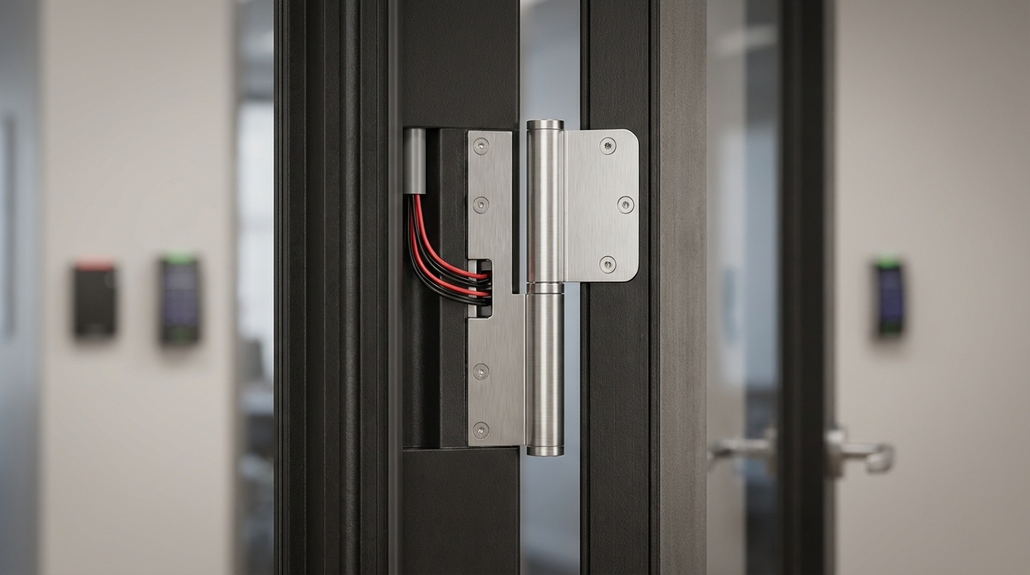
Electrified hinges conceal all wiring within the hinge barrel, providing the cleanest aesthetic appearance with no exposed conduit, wire, or power transfer devices visible on the door or frame. Power and signal wires run through the hinge pin cavity, transferring between frame and door automatically during door operation. The concealment suits high-end commercial buildings, corporate offices, healthcare facilities, and any application where exposed wiring compromises architectural aesthetics or creates cleaning and maintenance complications.
Standard electrified hinges accommodate 4-12 wires depending on model and manufacturer. McKinney TA series electrified hinges provide 4-wire and 8-wire configurations, while specialized models handle up to 12 conductors for complex access control systems. The wire gauge typically runs 22 AWG to 18 AWG--adequate for low-voltage access control power and signals but insufficient for high-current applications. Wire count and gauge determine which devices the hinge can power; simple electric strikes need 2-4 wires, while card readers with REX sensors and door position switches require 8-12 conductors.
The hinge pin in electrified models is hollow, containing the wire bundle running through its length. The pin must remain stationary during door operation while the hinge knuckles rotate around it--this fixed-pin design differs from standard hinges where the pin is press-fit and removable. The stationary pin requirement affects installation; electrified hinges must install with proper pin orientation and cannot use standard hinge installation techniques that involve pin insertion after hanging the door.
Installation Requirements and Frame Prep
Electrified hinge installation requires routing wire through the door frame from the hinge mounting location to the access control panel location. Hollow metal frames typically include wire chases--internal pathways allowing wire routing without exposed conduit. Wood frames need routing channels drilled or routed through frame members, or surface conduit if concealed routing is impractical. The frame preparation must complete before hinge installation since accessing frame internals after hinge mounting proves difficult.
Door preparation involves routing wire from the hinge location to the electric strike, mag lock, or other powered device location. The routing typically runs through the door edge in a vertical channel, though some installations route through the door core when edge routing would interfere with lockset preparation. Solid core wood doors accept edge routing readily, while hollow metal doors may need supplemental reinforcement where routing removes structural material.
Standard electrified hinge installation requires one electrified hinge per door, typically installed in the middle hinge position on three-hinge doors or the second position on doors with four or more hinges. The remaining hinges use standard non-electrified models. For high-security applications or doors with numerous powered devices requiring high conductor counts, some installations use two electrified hinges--typically positions two and three on four-hinge doors--doubling available wire capacity.
Surface Door Loops for Retrofit Applications
Loop Construction and Mounting
Surface door loops mount on the door and frame with flexible conduit or armored cable connecting the two mounting blocks. The loop allows door operation while protecting wires from pinching or damage through spring-loaded or coiled cable design that expands and contracts with door movement. Door loops provide the most cost-effective retrofit solution since they require no door or frame modification--simply mount the blocks with screws and route wiring externally from power source to devices.
Standard door loops accommodate 4-8 wires in 18 AWG to 22 AWG gauge. The flexible conduit or armored cable provides physical protection for conductors against abrasion, impact, and environmental exposure. Better quality loops use stainless steel armored cable rather than plastic conduit, providing superior durability in high-traffic or abuse-prone applications. The cable includes strain relief at both mounting blocks preventing wire fatigue from repeated flexing during thousands of door cycles.
Mounting blocks attach to the door top edge and frame head typically, though some installations use side-mounted configurations when overhead mounting is impractical. The blocks require solid mounting surfaces--wood blocking in hollow metal frames or reinforced areas on doors. Surface mounting makes installation straightforward but creates aesthetic concerns in finished spaces where exposed hardware detracts from architectural appearance.
Operational Considerations and Limitations
The exposed wiring creates aesthetic concerns in high-end commercial spaces, corporate lobbies, healthcare patient areas, or any application where visible conduit conflicts with design intent. The surface-mounted hardware also presents physical vulnerability in high-abuse applications--correctional facilities, psychiatric hospitals, schools with significant vandalism--where exposed conduit invites tampering or intentional damage.
Door loops restrict door opening angles compared to electrified hinges or through-door power transfers. The cable length limits maximum door opening--typically 120 to 135 degrees--beyond which the cable reaches maximum extension and prevents further opening. Applications requiring 180-degree door opening or doors held open routinely cannot use standard door loops without specialized extended-length models that cost 60-80 percent more than standard configurations.
Cable fatigue represents the primary failure mode for door loops. Repeated flexing through millions of door cycles eventually breaks individual conductors within the cable bundle. High-frequency doors--hospital corridors, retail entrances, institutional facilities with continuous traffic--may experience cable failure in 3-5 years versus 8-10 year life in moderate-traffic applications. For applications requiring surface power transfer with extended service life, consider heavy-duty door loops rated for high-cycle institutional use.
Through-Door Power Transfer Devices
High Wire Count Capacity
Through-door power transfer devices install in holes drilled through the door top edge and frame head, with spring-loaded contacts maintaining electrical connection as the door swings. These devices accommodate high wire counts--16 to 32 wires typical--supporting complex access control systems with multiple readers, sensors, and locks requiring more conductors than electrified hinges or door loops provide. The high capacity suits applications with card readers, REX sensors, door position switches, request-to-exit devices, and electric locks all requiring separate power and signal circuits.
The device consists of two halves--one mounting in the door, one in the frame head--with spring-loaded pin contacts on one half engaging receptacle contacts on the other half. Door movement slides the pins within the receptacles maintaining electrical contact throughout the swing arc. Gold-plated contacts prevent corrosion and ensure reliable conductivity through hundreds of thousands of operation cycles. Better quality devices include sealed housings protecting contacts from dust and moisture that would degrade contact integrity.
Transfer device ratings specify maximum current per circuit and total device capacity. Typical devices handle 1-2 amps per circuit with 10-15 amp total capacity--adequate for multiple low-current access control devices but insufficient for high-current mag locks exceeding 500 milliamps draw. Verify device ratings match actual load requirements; overloading transfers causes voltage drop that prevents proper device operation or accelerates contact wear reducing service life.
Installation Complexity and Requirements
Through-door power transfer installation requires precise core drilling through the door top edge and frame head. The holes must align perfectly--misalignment exceeding 1/8 inch prevents proper contact engagement when the door closes. Drill the frame hole first using the frame head as reference, then mark the door hole location with the door positioned closed using the frame hole as a template. This sequence ensures alignment regardless of door or frame variations.
Hole diameter and depth are specified by the device manufacturer, typically 1 inch to 1-1/4 inch diameter by 2 to 4 inches deep. Solid core wood doors and hollow metal doors with adequate top rail height accept the drilling readily. Hollow core doors or doors with insufficient edge thickness cannot accommodate through-door devices without compromising structural integrity. Verify door construction adequacy before specifying this power transfer method.
Installation proves most practical during new construction or major renovations when doors and frames are accessible for drilling before final installation. Retrofitting power transfer devices to existing installed doors requires removing doors, drilling, and reinstallation--labor-intensive compared to surface door loop installation. The installation complexity makes power transfer devices less attractive for small projects but justified for large facilities where high wire count capacity provides long-term operational benefits.
Selection Criteria by Application Type
New Construction Specifications
New construction projects should prioritize electrified hinges for standard applications requiring 8 wires or fewer. The concealed wiring provides optimal aesthetics, and installation integrates into normal door hanging procedures without significant added labor. Specify electrified hinges in hardware schedules for any door with electric strikes, electric exit devices, or basic card reader systems not requiring excessive wire counts.
For complex access control doors needing 12+ wires--multiple readers, numerous sensors, electric locks with monitoring contacts--specify through-door power transfer devices. The higher installation cost justifies itself through elimination of multiple electrified hinges or the operational limitations surface door loops impose. Include power transfer devices in architectural drawings and door details ensuring frame manufacturers provide adequate preparation.
Retrofit Project Considerations
Retrofit applications favor surface door loops due to installation simplicity and minimal door/frame modification. The visible wiring trades aesthetics for practical installation in existing buildings where concealed routing is impractical. Specify heavy-duty armored cable loops for high-traffic applications accepting shorter service life in exchange for straightforward installation.
Electrified hinges suit retrofit projects only when door removal and reinstallation is already planned for other reasons--door replacement, frame repair, or major access control system upgrades justifying complete hardware replacement. The added cost of electrified hinges versus standard hinges is relatively small when hinges are being replaced anyway. For comprehensive access control installations requiring power transfer solutions, coordinate with electric strikes, card readers, and access control panels ensuring compatible power requirements across all devices.
Wire Sizing and Voltage Drop Calculations
Proper wire sizing prevents voltage drop that causes device malfunction--electric strikes fail to release, card readers reset randomly, or electronic locks operate intermittently. Calculate voltage drop using wire length from power supply to device, wire gauge, and device current draw. Standard access control operates at 12 VDC or 24 VDC; voltage drop limits typically allow 10 percent maximum--1.2 volts at 12 VDC or 2.4 volts at 24 VDC.
Wire gauge selection depends on circuit length and current. For circuits under 50 feet with current under 500 milliamps, 22 AWG suffices. Longer runs or higher currents require 18 AWG or 16 AWG to maintain acceptable voltage drop. Electrified hinges and power transfer devices typically include 22 AWG conductors--adequate for most applications but potentially undersized for long runs or high-current devices. Calculate voltage drop explicitly during design rather than assuming standard wire gauges work universally.
Multiple devices on single circuits require summing current draws for all devices on the circuit. A door with an electric strike drawing 250 milliamps, card reader at 100 milliamps, and REX sensor at 50 milliamps requires circuit capacity for 400 milliamps total. Running separate circuits to each device provides better reliability than sharing circuits, despite requiring more conductors through the power transfer mechanism.
Maintenance and Troubleshooting
Electrified hinges require minimal maintenance--the sealed wire routing protects conductors from environmental exposure and mechanical damage. Inspect wire connections at hinge terminals annually, checking for corrosion or looseness. Test device operation verifying proper function; intermittent operation suggests connection problems at hinge terminals or wire fatigue from improper installation allowing wire movement within the hinge barrel.
Door loop maintenance involves inspecting the flexible cable for damage--cracks in armor, exposed conductors, or cable stiffness indicating internal wire breaks. Replace loops showing visible damage immediately before complete failure occurs. Typical service life runs 5-8 years in moderate traffic, 3-5 years in high-frequency applications. Budget for loop replacement as consumable items requiring periodic renewal unlike electrified hinges or power transfer devices lasting 15-20 years.
Through-door power transfer devices need contact cleaning every 2-3 years in dusty or harsh environments. Disconnect power, separate door and frame halves, and clean contacts with electronic contact cleaner and lint-free cloth. Avoid abrasive cleaning that damages gold plating. Test contact resistance after cleaning; resistance exceeding 0.5 ohms indicates worn contacts requiring device replacement. Quality devices maintain low contact resistance through 500,000 to 1 million door cycles before wear necessitates replacement.