 SAME DAY & EXPEDITED SHIPPING AVAILABLE






Electrified Cylindrical Locks: Specification Guide
Posted by National Lock Supply on Mar 9th 2026
When access control is added to an opening that already has a cylindrical lock prep, the standard 2-1/8-inch cross-bore and 1-inch edge bore found in virtually every commercial door built in the last fifty years, the obvious options are to add a maglock, replace the strike with an electric strike, or replace the entire lock body with an electrified cylindrical lock. Each controls the opening in a fundamentally different way. An electric strike controls the frame. A maglock bypasses the lock body entirely. An electrified cylindrical lock controls the door-mounted lock body itself, specifically the lever's ability to retract the latch bolt, without requiring frame modification or additional hardware above the door.
What Makes a Cylindrical Lock Electrified
An electrified cylindrical lock adds a mechanism that controls whether the exterior lever can rotate the spindle, without changing how the door closes, latches, or is keyed. The electrification mechanism does not replace the lock body. It sits between the lever and the spindle. The door continues to close and latch mechanically at all times, and the interior lever always operates the latch regardless of power state, as required by NFPA 101 for free egress.
Three Electrification Mechanisms
Electric Clutch: Most Common for Retrofit
An electromagnetic clutch integrated into the lever chassis disengages the exterior lever from the spindle when de-energized, so the lever rotates freely without moving the latch bolt. When the clutch is energized by an access signal, it couples the lever to the spindle. The primary advantage is that an electric clutch lock uses the same door prep as a standard cylindrical lock, with no additional boring, no frame modification, and no wire channels beyond what is needed to bring power to the door. The Schlage ND-series and Corbin Russwin CL3800 series use this mechanism.
Solenoid-Driven: Most Responsive
A spring-loaded pin retracts when the solenoid is energized, allowing spindle rotation. Access events are near-instantaneous, but the solenoid produces an audible click on each access event. Appropriate for server rooms, utility closets, and industrial areas where solenoid noise is acceptable and access speed is a priority.
Motor-Drive: Highest Audit Trail Integration
A small DC motor directly drives the latch retraction and allows the lock to report latch position, door position, and access event data to the access control panel. Specified when comprehensive audit trails are required in healthcare medication rooms, financial record storage, and government secure areas.
Fail-Safe vs. Fail-Secure
Fail-safe means the exterior lever operates freely when power is interrupted and is required for doors on required egress paths. Fail-secure means the exterior lever remains disengaged when power is interrupted and is appropriate for storerooms and secure areas not on required egress paths. The interior lever always operates the latch regardless of fail mode, which is non-negotiable for NFPA 101 compliance.
When Electrified Cylindrical Is the Right Choice
The electrified cylindrical lock is correct when the door has an existing cylindrical prep and modifying it is not practical, when the access control requirement is to control the lever itself rather than the frame side, when the installation requires minimal visible hardware, and when cost is a primary constraint in a retrofit project. When the door already has a mortise prep, compare with electrified mortise locks to confirm which product matches the existing door preparation.
Power Requirements and Wiring
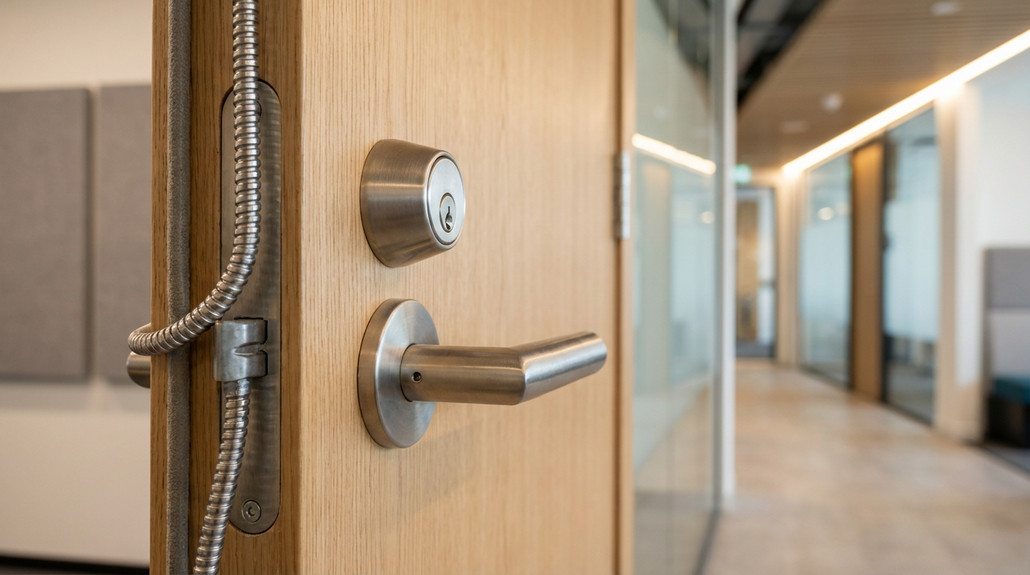
Electrified cylindrical locks require low-voltage DC power delivered to the lock body through the door. Electrified hinges with concealed wiring are the cleanest installation method and the standard for new construction. A door cord or power transfer loop is less expensive and easier to retrofit but is visible and subject to mechanical wear. The electrified hinges vs door loops guide covers the trade-offs between each wiring path in detail.
Access Control Integration
Electrified cylindrical locks connect to access control panels through standard Wiegand output readers. A Request-to-Exit device is required on fail-safe applications. The REX device guide covers sensor types and mounting positions compatible with electrified cylindrical lock circuits.
Top Models
Schlage ND-series electrified is the most widely specified electrified cylindrical lock in commercial applications: electric clutch, available in every ANSI function, Grade 1. Corbin Russwin CL3800 uses an electric clutch design with strong presence in healthcare and education. Sargent 10-line electrified is specified alongside Sargent exit devices and closers for coordinated package projects.