 SAME DAY & EXPEDITED SHIPPING AVAILABLE






Continuous Geared Hinges: Sizing, Specs & Common Mistakes
Posted by National Lock Supply on Dec 16th 2025
Continuous hinges run the full height of the door, distributing load across the entire hinge length rather than concentrating stress at three or four standard hinge locations. This design eliminates door sag common in high-traffic installations, provides inherent security through full-length engagement preventing prying attacks, and delivers institutional-grade durability in abuse-resistant applications. Geared continuous hinges add a gear mechanism at each pin location, providing precise door control and extended service life exceeding standard continuous hinges by 200-300 percent.
Specifying continuous hinges requires understanding load calculations, mounting methodology, fire rating requirements, and common installation errors that compromise performance. Browse continuous hinges from McKinney, Hager, and Pemko for institutional-grade door control.
Geared vs Standard Continuous Hinge Design
Standard Piano Hinge Construction
Standard continuous hinges use a piano-style pin running the full length with knuckles every 2-3 inches along the hinge length. The continuous pin threads through all knuckles, with the door leaf and frame leaf knuckles alternating along the length. This simple design provides full-length load distribution at low cost--standard aluminum continuous hinges cost $40-80 for 7-foot lengths depending on width and gauge.
The limitation involves friction between knuckles during door operation. With dozens of knuckle interfaces along the hinge length, cumulative friction creates significant resistance. This friction increases over time as dirt accumulates in knuckle gaps, lubrication depletes, and wear roughens bearing surfaces. Doors with standard continuous hinges often develop binding or squeaking within 2-3 years of installation in high-traffic applications.
Standard continuous hinges also lack precise door control. The long flexible pin allows slight twisting under uneven loads, creating door warping or misalignment. Heavy doors or doors subjected to wind pressure show visible twist--the top and bottom of the door do not remain parallel as the door opens, affecting weatherstripping compression and creating binding at the lock edge.
Geared Continuous Hinge Advantages
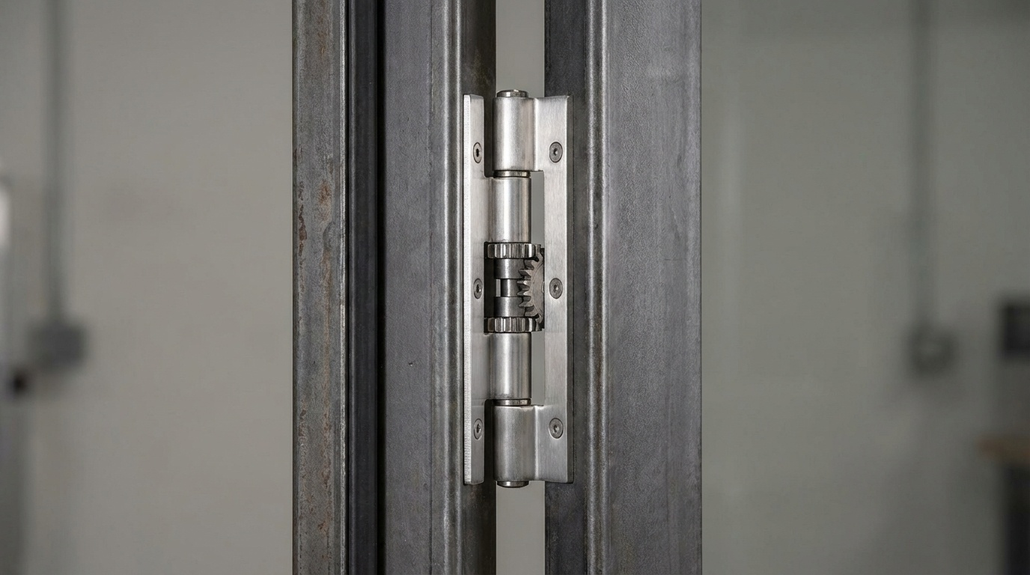
Geared continuous hinges incorporate precisely machined gears at each knuckle location--typically every 2 inches along the hinge length. Each gear pair meshes with adjacent gears, synchronizing movement along the entire hinge length. This gear train eliminates the twisting and binding that plague standard continuous hinges. The door remains perfectly aligned throughout its swing arc regardless of load distribution or external forces.
The gear mechanism distributes loads more evenly across the hinge length. Rather than individual knuckles bearing localized loads, the intermeshed gears spread forces along multiple gear pairs. This load distribution reduces peak stress at any single point, dramatically extending service life. Geared continuous hinges tested to 25 million cycles--equivalent to 40-50 years in high-traffic institutional applications--versus 5-8 million cycles for standard continuous hinges.
Geared hinges operate more smoothly with less friction than standard designs. The rolling contact between gear teeth creates lower friction than the sliding contact between plain knuckles. Doors equipped with geared continuous hinges require less opening force, improving ADA compliance and reducing closer workload. The reduced friction also means geared hinges maintain smooth operation longer without lubrication compared to standard hinges requiring regular maintenance.
Load Calculations and Sizing Requirements
Door Weight and Material Factors
Continuous hinge sizing depends on door weight, material, and traffic volume. Calculate door weight by multiplying door dimensions by material density: solid core wood runs 3-4 pounds per square foot, hollow metal doors 5-7 pounds per square foot depending on gauge and core, and aluminum doors 2-3 pounds per square foot. A 3 foot by 7 foot solid core wood door weighs approximately 85-95 pounds, while an equivalent hollow metal door weighs 105-147 pounds.
Add hardware weight to base door weight--locksets, closers, and panic hardware can add 15-25 pounds total. A 3-0 by 7-0 hollow metal door with mortise lock, surface closer, and overhead stop weighs approximately 130-150 pounds total. This total weight determines minimum hinge capacity requirements. Never size hinges exactly to door weight--always specify hinges rated for 150 percent of actual weight providing operational margin and extended service life.
Material properties affect hinge selection beyond simple weight. Steel doors concentrate weight toward edges where hinge attachment occurs, creating higher localized stresses than wood doors with more evenly distributed weight. Glass doors create dynamic loads as glass panels flex during operation, requiring hinges with enhanced load capacity despite relatively light total weight. Specify hinges conservatively for non-standard door materials.
Hinge Width and Load Capacity
Continuous hinge width--the leaf dimension perpendicular to the pin--determines load capacity. Narrow 2-inch leaf hinges suit lightweight doors up to 150 pounds in moderate traffic applications. Standard 3-inch leaf hinges handle doors 150-300 pounds with normal institutional traffic. Wide 4-inch leaf hinges accommodate heavy doors exceeding 300 pounds or extreme-duty applications with significant abuse or wind loading.
The width affects moment arm--the distance from the pin centerline to the fastener line. Wider hinges place fasteners farther from the pin, increasing mechanical advantage but also increasing bending moment on the hinge leaf. This requires thicker gauge material in wide hinges maintaining adequate stiffness. A 4-inch hinge needs heavier gauge than a 2-inch hinge handling equivalent door weight.
Material gauge specifications follow width. Aluminum continuous hinges use 0.080 to 0.125 inch thickness depending on width and load rating. Steel hinges run 0.060 to 0.105 inch gauge for equivalent load capacities--steel higher strength allows thinner material for equal performance. Stainless steel uses similar gauges to standard steel but costs 150-200 percent more, justified only for corrosive environments or high-security applications requiring superior attack resistance.
Fire Rating Requirements and Testing
Continuous hinges used on fire-rated assemblies must carry UL listings matching or exceeding the door assembly rating. UL 10C testing subjects complete door assemblies--including hinges--to standardized fire exposure verifying the assembly prevents flame passage and maintains structural integrity through the rated duration. A 90-minute fire door requires hinges tested and labeled for minimum 90-minute performance.
The testing evaluates hinge performance under extreme conditions. Temperatures exceed 1400 degrees F, expanding metal components and degrading lubrication. Positive pressure testing simulates building pressurization during fires, applying forces attempting to push the door open. The hinges must maintain door alignment and prevent gap opening that would allow flame passage. Geared continuous hinges meet these requirements through robust construction and heat-resistant materials.
Fire-rated hinge labels must remain visible after installation. Painting over labels or removing them voids the fire rating regardless of the hinge actual capabilities. Inspectors check for visible labels during certificate of occupancy inspections and fire marshal reviews. Maintain hinge packaging showing UL listing information in building records supporting future inspections or renovations requiring fire rating verification.
Installation Procedures and Fastening Methods
Fastener Selection and Spacing
Continuous hinge installation requires fasteners every 3-4 inches along the full hinge length--significantly more fasteners than standard butt hinges using 3-4 screws per hinge. A 7-foot continuous hinge needs 20-25 fasteners per leaf, totaling 40-50 fasteners for complete installation. This extensive fastening distributes loads evenly preventing localized stress that causes screw pullout or door edge damage.
Fastener type depends on door and frame material. Wood doors use #8 or #10 wood screws minimum 1 inch length penetrating solid door edge material. Hollow metal doors require sheet metal screws threading into door edge metal or machine screws engaging internal reinforcement. Aluminum doors need specialized fasteners--either aluminum screws preventing galvanic corrosion or stainless steel fasteners with isolation washers.
Pre-drill all fastener holes preventing door edge splitting in wood or edge deformation in metal doors. Use drill bit diameter 75 percent of screw shank diameter for wood, or tap drill size for machine screw threads in metal. Drilling the complete hinge fastener pattern before installing any fasteners ensures accurate alignment and prevents cumulative errors that create binding or gaps.
Alignment and Shimming Requirements
Continuous hinge installation demands perfect alignment along the full door height. Even minor misalignment--as little as 1/16 inch over a 7-foot length--creates binding preventing smooth operation or causing premature hinge wear. Use a straightedge along the hinge length during installation verifying the hinge remains perfectly straight without bowing or twisting.
Shim behind hinge leaves as needed maintaining perfect alignment despite door edge or frame irregularities. Door edges may not be perfectly straight--wood doors can have slight crowning or warping, metal doors may have edge welds creating high spots. Shimming compensates for these irregularities creating a perfectly straight hinge mounting surface. Use thin cardstock or commercial hinge shims, typically 0.010 to 0.030 inch thickness.
Pin installation completes continuous hinge mounting. The pin inserts from the top, threading through all knuckles along the full hinge length. Support the door during pin installation preventing it from swinging or shifting. Apply light lubrication to the pin facilitating insertion through dozens of knuckle interfaces. For comprehensive hardware packages requiring continuous hinges, coordinate with door closers and exit devices ensuring compatible operation and load distribution.
Common Specification and Installation Errors
Undersizing for Door Weight
The most common continuous hinge error involves specifying hinges inadequate for actual door weight. Specifiers calculate door weight but forget to add hardware, or fail to account for wind loads on exterior doors, or underestimate traffic-induced dynamic loads. These underestimated loading conditions cause premature hinge failure--sagging, binding, or complete mechanical failure requiring emergency replacement.
Always size continuous hinges for 150 percent of calculated door weight minimum. For doors experiencing wind exposure, add 50-100 pounds equivalent load accounting for wind forces attempting to open or slam doors. High-traffic applications with continuous heavy use justify similar load additions compensating for dynamic loading during operation. The modest cost increase for heavier-duty hinges proves insignificant compared to premature failure costs and operational disruption.
Inadequate Door Edge Preparation
Continuous hinges require straight, square door edges along the full hinge length. Doors with crowned edges, twisted faces, or irregular edge conditions create installation problems. The hinge cannot conform to irregular edges--attempting to force the hinge flat creates internal stresses that cause binding or accelerated wear. Sand or plane door edges straight before hinge installation, using a straightedge verifying perfect linearity.
Edge preparation also includes ensuring adequate edge width for fastener installation. The hinge leaf must sit fully on the door edge without overhanging--overhanging creates unsupported hinge sections that flex under load. Standard 1-3/4 inch thick doors provide adequate edge width for 2-inch and 3-inch leaf hinges. Narrow stile doors or doors with beveled edges may need custom narrow-leaf hinges or alternative mounting methods.
Maintenance and Service Life Optimization
Geared continuous hinges require minimal maintenance--the sealed gear train resists dirt intrusion and retains lubrication far longer than standard continuous hinges. Annual inspection verifies fastener tightness and hinge alignment. Tighten any loose fasteners immediately preventing progressive loosening that allows door sag. Check door operation smoothness; binding or unusual noise suggests developing problems requiring investigation.
Lubrication intervals extend significantly compared to standard hinges. Geared continuous hinges typically need lubrication every 3-5 years versus annually for standard continuous hinges. Apply light machine oil or spray lubricant to the hinge pin and visible gear teeth, operating the door through several cycles distributing lubricant throughout the gear train. Avoid heavy grease that attracts dirt creating abrasive contamination accelerating wear.
Service life for quality geared continuous hinges exceeds 20 years in normal commercial applications, 10-15 years in heavy institutional use with extreme traffic volumes. Indicators for replacement include visible gear tooth wear, persistent binding despite lubrication, or looseness between door and frame exceeding 1/8 inch. These conditions signal the hinge has reached service life limits requiring replacement before complete failure occurs.