 SAME DAY & EXPEDITED SHIPPING AVAILABLE






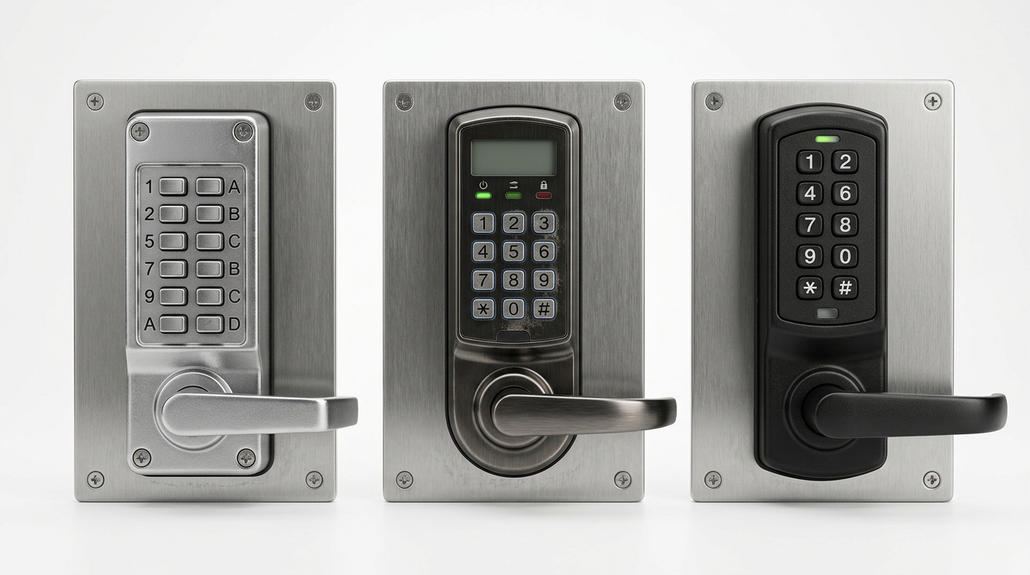
Alarm Lock DL2700 vs Schlage FE595 vs Kaba Simplex
Posted by National Lock Supply on Apr 9th 2026
A commercial keypad lock is a standalone electronic or mechanical lock that opens on a numeric code entered at the door, without cylinder keys or a central access-control server. The three models that dominate this category in the U.S. are the Alarm Lock Trilogy DL2700 (electronic, battery-powered, with audit trail), the Schlage FE595 (electronic, battery-powered, Grade 2 residential/light commercial), and the Kaba Simplex 1000 (fully mechanical, no batteries, no electronics). They look like they do the same thing — they do not. This guide explains which opening gets which lock and why.
For the fundamentals on keypad vs prox vs smart locks, start with Keypad vs Proximity Entry for Doors: Detailed Comparison and Smart Commercial Door Locks: Complete Guide.
Quick verdict
- Alarm Lock DL2700 → the right answer for small business access control without a server. Up to 100 users, audit trail, ANSI Grade 1, battery-powered, no wires. Used in gyms, dental offices, small office suites, storage facilities, and property management common areas.
- Schlage FE595 → the right answer for light commercial and multi-tenant residential. Grade 2, simpler user management, Schlage-compatible keyway as a mechanical backup. Used in Airbnb, small retail, vacation rentals, and small office interior doors.
- Kaba Simplex 1000 → the right answer when batteries are a liability. Fully mechanical, no power required, no audit trail, no user list. Used in mechanical rooms, server rooms, telecom closets, and any opening where a dead battery would cost more than the lock.
Entity attributes side-by-side
|
Attribute |
Alarm Lock DL2700 |
Schlage FE595 |
Kaba Simplex 1000 |
|---|---|---|---|
|
Type |
Electronic keypad |
Electronic keypad |
Mechanical keypad |
|
Power |
5x AA batteries |
4x AA batteries |
None |
|
ANSI/BHMA grade |
Grade 1 (A156.25) |
Grade 2 (A156.36) |
Grade 1 (A156.2) |
|
Max user codes |
100 |
19 |
1 shared combination |
|
Audit trail |
40,000 events |
None |
None |
|
Mechanical key override |
Optional SFIC |
Schlage C keyway |
Optional cylinder |
|
Battery life |
~3 years (~80,000 cycles) |
~2 years (~15,000 cycles) |
N/A |
|
Programming |
Keypad or AL-DTM handheld |
Keypad |
Mechanical (combo change) |
|
Finishes |
5 architectural |
4 residential/light commercial |
5 architectural |
|
Fire rating |
UL 10C optional |
UL 10C listed |
UL 10C listed |
|
Typical price tier |
Mid-premium |
Entry |
Premium (no electronics premium) |
|
Best vertical |
Offices, property managers, fitness |
Airbnb, vacation rental, retail |
Mechanical/electrical rooms |
All three are surface- or cylindrical-bore mounted and fit a standard 2-1/8” door prep. If your door prep is non-standard or you need a mortise-bodied keypad lock, that is a different product category — see our Smart Commercial Door Locks Complete Guide.
Alarm Lock DL2700: the small-business standard
The Alarm Lock Trilogy DL2700 is the entry point of Alarm Lock’s Trilogy family and the best-selling standalone electronic commercial keypad lock in the United States. It is a Grade 1 cylindrical lever lock that stores up to 100 user codes, logs 40,000 audit events, and runs for about three years on five AA alkaline batteries. It does all of this without a server, panel, or wired infrastructure.
Choose the DL2700 when:
- The building needs real access control but cannot justify a central panel (Mercury, HID, Lenel, Axis).
- The owner or property manager needs to audit who opened the door and when — this is the single feature that disqualifies the FE595 and Simplex from most compliance-driven jobs.
- Door count is under 25, above which a networked solution usually beats the per-door labor of managing standalone locks.
- The opening is a front door, tenant suite, gym, daycare, medical office, or storage unit — typical Trilogy use cases.
- You need Grade 1 durability on an exterior door.
Skip the DL2700 when:
- Door count exceeds 50 and the owner is willing to wire. At that scale, prox readers plus a panel are cheaper in total cost of ownership.
- The opening is an interior office or a vacation rental — the FE595 costs less and is enough.
- Power cannot be guaranteed (including batteries — the DL2700 fails locked when batteries die, unless ordered with the key override, which adds cost).
The DL2700 is also the anchor of the larger Trilogy catalog (DL2800, DL3000, DL6100 networked). If any of those are on your radar, ask for a comparison.
Shop stocked Alarm Lock Trilogy models in the Electronic Keypad Locks category or browse the full Keypad & Prox Locks parent category.
Schlage FE595: the light commercial keypad
The Schlage FE595 is the light-commercial workhorse of Schlage’s residential electronic catalog. It is a Grade 2 lock with up to 19 user codes, a standard Schlage C keyway as a mechanical backup, and a simple keypad programming interface. It does not log audit events. It is not a replacement for a Trilogy lock, and pretending it is will create compliance headaches in any regulated environment.
Choose the FE595 when:
- The opening is a vacation rental, Airbnb, small retail stockroom, or interior office where the user list is small and stable.
- Owner or property manager wants a mechanical key backup on a Schlage C keyway — so the lock ties into an existing keyed building.
- Budget is the top constraint and Grade 2 is acceptable (not an exterior entrance on a high-traffic building).
- The opening is part of the 20-to-1 Airbnb pattern — one code per booking, rotated between guests.
Skip the FE595 when:
- You need an audit trail. The FE595 has none.
- You need more than 19 user codes.
- The door is an exterior entry on a commercial building — Grade 2 will not hold up to the cycle counts.
Shop Schlage FE595 and related electronic keypad locks in the Electronic Keypad Locks category. For the specific pattern of using a keypad lock on short-term rentals, our Why Keypad Door Locks Are a Must-Have for Airbnb Rentals article covers it.
Kaba Simplex 1000: the mechanical specialty
The Kaba Simplex 1000 is a fully mechanical pushbutton lock — no electronics, no batteries, no audit trail, one shared combination. It is the right lock for openings where an electronic failure would be a bigger problem than the lack of audit: mechanical rooms, server rooms, telecom closets, utility rooms, and any door that must open reliably for decades without maintenance visits.
Choose the Simplex 1000 when:
- The opening is a mechanical, electrical, telecom, or server room inside an otherwise-keyed building.
- The facility owner wants to eliminate the cost of battery replacement and the risk of lockout.
- Only one shared code is needed and the user list is small, stable, and trusted.
- The door must meet Grade 1 and carry a UL 10C fire label.
- The opening cannot tolerate a dead-battery failure mode — the Simplex has none.
Skip the Simplex 1000 when:
- Two or more different user codes are needed. The Simplex is one-combo only.
- The owner needs an audit trail or remote re-keying — go to a Trilogy or a networked lock.
- User turnover is high — changing a Simplex combination requires partial disassembly.
The Simplex family (1000, 3000, 5000, L1000) lives in the Mechanical Pushbutton Locks category — the right subcategory for any fully mechanical keypad lock.
Decision matrix
|
Opening |
Lock |
|---|---|
|
Exterior entry on small business, gym, dental office, storage facility |
Alarm Lock DL2700 |
|
Airbnb or vacation rental front door |
Schlage FE595 |
|
Small retail stockroom / back-of-house |
Schlage FE595 |
|
Mechanical room / server room / telecom closet |
Kaba Simplex 1000 |
|
HIPAA-driven audit requirement |
Alarm Lock DL2700 (audit trail) |
|
Multi-tenant property (10+ users per door) |
Alarm Lock DL2700 |
|
Fire-rated stair door with single-combo access |
Kaba Simplex 1000 |
For the specific case of keypad locks in healthcare, How Keypad Locks Are Securing Healthcare Facilities walks through HIPAA considerations.
Common install mistakes to avoid
- Specifying Grade 2 on an exterior door. The FE595 is not rated for heavy exterior cycling. Use the DL2700 or a Grade 1 networked option instead.
- Assuming the Simplex has an audit trail. It does not. If you need to know who entered, the Simplex is the wrong product.
- Forgetting battery replacement budget on the DL2700. Plan for a battery swap every 2–3 years per door.
- Picking a keypad lock when the real need is access control. If the door count is over 50 and the owner needs provisioning, scheduling, and centralized audit, standalone is the wrong architecture.
- Skipping the mechanical key override on the DL2700. Order with SFIC prep if the building is on an IC core system — saves a truck roll when batteries die.
For a general pre-purchase checklist, Mistakes to Avoid When Buying Door Locks is the reference.
FAQ
Does the Alarm Lock DL2700 require a power supply? No. It is battery-powered, fully standalone, and installs in under 45 minutes on a pre-prepped cylindrical door.
How many codes does the FE595 support? Nineteen user codes plus one master. If you need more, step up to a Trilogy model.
Is the Simplex 1000 really lock-for-life? Mechanical, yes — the internal mechanism is rated for hundreds of thousands of cycles. The wear point is the pushbuttons themselves, which are field-replaceable.
Can I integrate any of these with an access-control panel? The DL2700 is standalone-only. Alarm Lock’s networked siblings (DL6100, Trilogy Networx) integrate with access control. The Simplex and FE595 do not integrate at all.
Which one is fire-rated? All three are UL 10C listed on fire doors when ordered with the correct prep. Confirm the specific model number carries the fire label before ordering.