 SAME DAY & EXPEDITED SHIPPING AVAILABLE






ADA Compliance for Commercial Door Hardware
Posted by National Lock Supply on Mar 11th 2026
ADA compliance in commercial door hardware is not a single standard applied uniformly to every door. It is a collection of specific requirements, each applying to a specific type of door in a specific context: operating force, hardware shape, mounting height, threshold height, and maneuvering clearance. ADA violations in commercial buildings are almost always specification failures, not installation failures. The wrong hardware type was chosen for the opening.
Who ADA Applies To
Title II covers state and local government facilities. Title III covers places of public accommodation including offices, retail, healthcare, hospitality, and restaurants. Both require new construction and alterations to comply. ADA compliance is not required only for buildings that currently serve users with disabilities. It applies to all places of public accommodation regardless of current user demographics.
The Full Requirements Checklist
- Hardware operable with one hand without tight grasping, pinching, or twisting of the wrist. Round doorknobs are not ADA-compliant on accessible routes.
- Opening force maximum 5 lbf for interior doors on accessible routes.
- Mounting height 34 to 48 inches above finished floor (AFF) for all operable hardware.
- Threshold height maximum 1/2 inch total, with edges beveled at 1:2 maximum slope for heights exceeding 1/4 inch.
- Door width minimum 32 inches clear opening.
ADA-Compliant Lever Handles
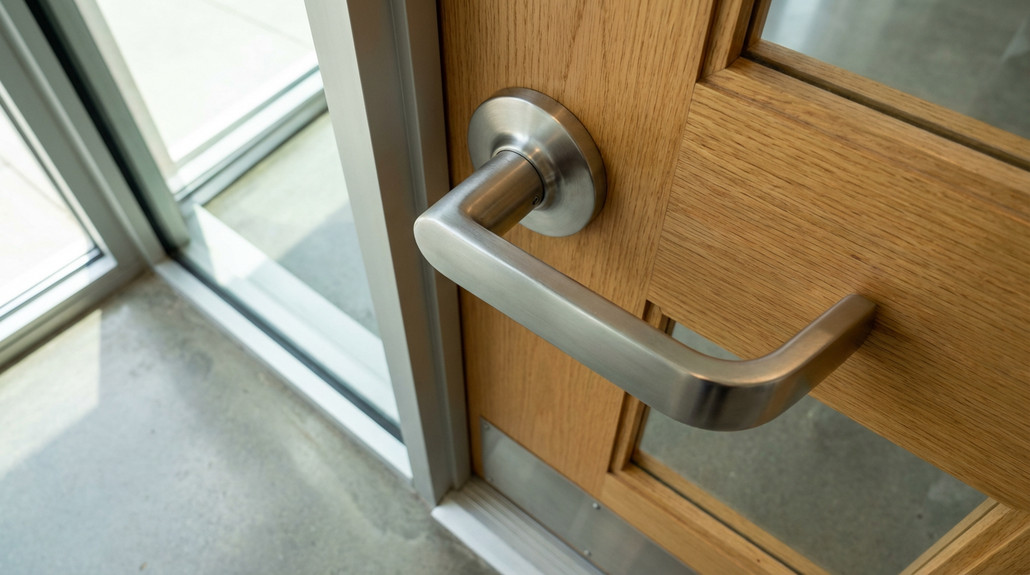
ADA specifies an operational requirement, not a particular lever shape: the lever must be operable with the side of a closed fist without requiring grip or rotation. Most commercial lever handles satisfy this. Lever handles that do not satisfy ADA include any lever with a return curl requiring gripping, any lever requiring a simultaneous thumb-piece, and any lever requiring two simultaneous hand operations.
The [complete commercial lever door handle guide](https://nationallocksupply.com/blog/complete-guide-to-commercial-lever-door-handles/) covers ADA-compliant shapes across cylindrical and mortise applications. The cylindrical lever lock selection at National Lock Supply covers Grade 1 ADA-compliant options in all standard ANSI functions.
Door Closers and ADA Opening Force
Most commercial door closers are adjusted at installation for reliable latching, producing 6 to 8 lbf of opening force, and are then never readjusted. A simple sweep valve adjustment on most Grade 1 closers brings opening force within the 5-pound limit without affecting reliable latching on standard interior doors. When a door closer cannot achieve ADA compliance at the force level needed to reliably close and latch the door, a low-energy power operator is the correct solution.
Restrooms and ADA
Restroom doors on accessible routes require privacy hardware operable from inside by a person with limited hand function. Thumb-turn privacy locks satisfy this requirement when the thumb-turn can be operated with a closed fist. The commercial bathroom door lock guide covers privacy set selection for accessible restroom applications.
Exit Doors and ADA
Panic bars satisfy ADA operable parts requirements by design because the push motion requires no grasping. They simultaneously satisfy ADA and NFPA 101 free egress requirements. Push button egress devices provide ADA-compliant release for access-controlled doors and must be mounted within the 34 to 48 inch AFF range.
Thresholds and ADA
Thresholds exceeding 1/2 inch are barriers to wheelchair and rolling mobility device users regardless of how compliant the door hardware is. The Pemko saddle threshold guide identifies ADA-compliant profiles providing weather sealing within the height limits.
The Five Most Common ADA Violations
|
Violation |
Correction |
|---|---|
|
Round knob locks on accessible routes |
Replace with lever lockset in same prep, no frame modification |
|
Closer opening force exceeding 5 lbf |
Adjust sweep valve; Grade 1 closers reach 3-4.5 lbf with proper adjustment |
|
Thumb-turns requiring pinching force |
Replace with lever-operated privacy set or large flat-face thumb-turn |
|
Thresholds exceeding 1/2" without beveling |
Replace with ADA-compliant threshold before any other hardware work |
|
Hardware outside 34-48" AFF range |
Remount at compliant height regardless of hardware type |
ADA and Fire Code Conflicts
On fire-rated doors, ADA opening force requirements and NFPA 101 positive-latching requirements can conflict. A fire-rated door closer adjusted to 5 lbf may not have sufficient spring energy to close under positive fire pressure. The correct resolution is to install a low-energy power operator that provides hands-free access while maintaining the mechanical closer that ensures positive latching under fire conditions. The access control accessories guide covers the system-level coordination between power operators and fire alarm interfaces.